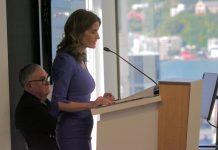
The Parliamentary Commissioner for the Environment, Simon Upton, wagged a metaphorical finger at the National Party on Saturday, and RMA Minister Chris Bishop wagged straight back.
A former National Party Environment Minister, Upton was a keynote speaker at the party’s Blue Greens Forum in Methven.
His speech went right to the heart of what is emerging as a potential fracture point inside the party.
“Understanding the environmental challenges we face isn’t a party political matter,” he said.
“The concentrations of CO2 in the atmosphere, nitrogen in the water or microplastic in living organisms are measurable, biophysical states.
“Dismissing these challenges as woke won’t change them one iota.”
After the speech, RMA Minister Christopher Bishop told the Forum he believed in a market economy based on property rights.
“And I think that is where we should go,” he said.

His colleague, Economic Growth Minister Nicola Willis, wasn’t quite as blunt, but her message was similar.
“It’s tempting to say let us do everything in the name of the environment and let us not pursue growth,” she said.
“But actually, what we know what that would lead to is a poorer country in which we are less able to invest in environmental initiatives.”
“It’s my observation that New Zealanders are more able to make sensible environmental decisions in their own family, in their own spending decisions, when they feel financially secure.”
Upton didn’t disagree with Willis on the need for growth, but he added an important caveat.
“We won’t be able to tackle the environmental challenges we face if we don’t have a successful economy,” he said.
“We need growth.
“The question for me is, what sort of growth?
“Will it be growth consistent with maintaining and improving the quality of the environment?
“Or just any old growth?”
Upton said that the economy was about turning natural capital into human and financial capital.
“The reality is that it’s a sort of piggy bank that we have been raiding for 150 years, and no one is really keeping tabs,” he said.
“No one, that is, except the environment itself.
“Because the environment is starting to send some invoices for services rendered.
“There are plenty more in the pipeline – and they’re becoming larger.”
It was not that the Ministers — and the Prime Minister — denied the need to consider environmental issues.
Instead, they tended to talk about broader policy planning but didn’t really address specific environmental issues.
That was left to the Blue Greens themselves.

During a question and answer session at the Forum, members asked RMA Minister Chris Bishop why there was no mention of the environment in the Fast Track Consents legislation.
Bishop replied bluntly that it was about planning, not the environment, which would seem to have ignored the fact that the whole point of the legislation was to stop what Ministers like Shane Jones have argued have been gratuitous environmental objections to plans.
The Blue Greens have a strong farming presence among their members; perhaps because the Forum was in Methven on the Canterbury Plains with its ongoing irrigation and nitrogen controversies, they made up a significant slice of those present at the weekend.
The co-chair of the Blue Greens, Northland MP Grant McCallum, is himself a dairy farmer, and he made a surprising admission to the Forum about Fish and Game’s 2002 “Dirty Dairying” campaign.
“Fish and Game were right to highlight this issue,” he said.
“As a Dairy farmer, I acknowledge this.
“So, the environment pushed back, to the point where some feel it was superseding economic, social, and cultural outcomes.”
However, McCallum warned that the campaign ended up with the rural sector being vilified, which he said he felt went too far.
“So where is the right balance?” he said.
“What are the environmental, economic, social, and cultural outcomes we can all live with?
“I suspect we will never get complete agreement on this, but we must try.”
“So, let’s focus on making process for nature, for the economy and for the people who live in New Zealand.
“After all, nature is our true capital.”
This question of where to draw the line between the economy and the environment dominated the Forum.
Upton recalled the debates of the 1980s when he was an MP and intriguingly reminded his audience that the debates were not only between parties but also “just as importantly” within them.
That sounded like an incitement to the Forum to challenge the policies being pushed by the Government ministers.
What became clear was that there was little enthusiasm among the Ministers for a bipartisan approach, which might have required compromise on their part.
It was a question picked up by Tracey Brown, the chair of Dairy NZ.
“We need certainty in the future because some of this stuff is long-term,” she said.
“How much certainty can you give us that you will work hard, particularly on climate (change) and water, to try and getcross-party agreement on how this should be going forward?”
“This is a question we get asked a lot. How can you pursue bipartisan change,” Willis replied.
“Well, I’m going to be really blunt with you.
I look back over the past six years, and frankly, I think the last Government was pretty anti-dairy, pretty anti-farmer.
“That was how I perceived the regulatory approach. That was how I perceived the way that they blamed environmental issues on particular sectors.
“Now, I disagreed with that approach, and I was proud to campaign for a National Party that said, we’re going to get the balance a bit better in terms of the way we regulate our farmers.
“We appreciate how important they are to our future, and we know that our farmers are the most efficient and sustainable in the world, so we don’t benefit by punishing them, so we will continue to promote policies that put those principles forth.
“And I absolutely celebrate those who wish to go and speak to my friends on the other side of the political aisle about why they should support those policies.
“But ultimately, our focus has to be on delivering for farmers today rather than dissuading our friends across the aisle.”

The Blue Greens have long campaigned to liberalise the laws restricting genetic modification and editing.
Parliament’s Health Committee is about to begin hearings on the Gene Technology Bill 2024, which will enable a more widespread use of gene editing.
However, there are suspicions both within the Caucus and among those interested in seeing the bill proceed that some agriculture sector organisations are starting to get cold feet and are not entirely supportive of liberalisation.
Dr William Rolleston, a former Federated Farmers president and chair of the pro-GE Life Sciences Network, spoke to the Forum and addressed this question.
“A typical bunch of submissions (to a Select Committee) on this sort of subject, it’s usually 15,000 against and 40 or in favour,” he said.
“But that is not what they should be looking at.
“Of course, keep that in mind, but they should be looking at the veracity of the evidence that’s in front of them.
“If someone says, I want New Zealand to be GE free because we’re all going to go handbasket and we’re all going to die, that’s not a credible solution.
“The submissions need to be credible, and I think that’s going to be a big task for the Select Committee to actually work through that and do the job they’re paid to do.”
However, legislation is one thing; the way it is administered is another.
Simon Upton made the case for decentralisation and for bringing local communities into the debate.
“We need a system that strikes a balance between central and local government on the one hand and community action on the other; a system that encourages people to work together to understand what to say, then change behaviours and learn how they can make progress in their patch,” he said.
“And that’s the crucial thing.
“Every patch is different, which is why I’ve tried to persuade both this Government and the last Government to take a more experimental approach rather than one rule for all.
Upton suggested the Government could be the source of information, but local communities could then decide what to do.
However, that is clearly not the approach guiding the reform of the Resource Management Act.
Bishop was highly critical of the fragmentation of the current planning system and (like Labour with its reforms) is proposing that there be only a limited number of regional plans.
He is proposing 13.
There are currently 53 District Councils in New Zealand, each of which administers a District Plan.
For many, that is one of their main functions.
The logical consequence of that would be a rationalisation of the number of district and regional councils.
This would almost certainly buy a fight with Federated Farmers who opposed Labour’s planning rationalisation because it shifted land use planning away from democratically elected councils towards Regional Planning Committees, which would be at arm’s length from their local community,
This doesn’t seem to faze Bishop.
“I think people in this room know it, there’s a discussion around local government,” he said.
“Unitary versus district Councils, cities, the role of regional councils.
“Once you start having conversations about reducing our number of plans, streamlining the functions, reducing the effects that the system can focus on, all that sort of stuff and where the environmentalmonitoring and compliance sits, that’s going to be a live question.
“I’m not going to go into it today, but I think people know the debate is going to come.”
At the heart of that debate is a fundamental tension between what Willis and Bishop want and what the Blue Greens stand for.
Because of the rural base that underpins the Blue Greens, they want planning legislation that deals with the big environmental issues.
But for Ministers like Bishop and Willis, the purpose of the legislation is to enable economic growth.
Bishop blamed the RMA for the lack of productivity growth in New Zealand over the past 30 years.
He talked about the need to dismantle “our obstruction economy and embed a culture of yes and rejecting the culture of no that is set into decision-making in this country.”
Comments like these clearly provoked some unease among Forum members.
One had a warning for the Forum.
“I think one of the things we’ve got to be very careful is that we have a view that the only way we can achieve GDP growth is by actually removing environmental protections,” he said.

The Prime Minister was listening to the debate and appeared to be making notes and alterations to his speech notes as it proceeded.
“Now, some of you in this room will say, well, how do we actually square growth away with environmental protection?” he said.
“And some of the conversations we’ve had already this morning have reiterated that.
“New Zealand needs to be a place where people actually want to live.
“And an important part of that is obviously protecting our natural environment.
“And one of this country’s great strengths is the beauty of our incredible landscapes, as you all well know, and our unique native flora.
“We’ve got to protect that legacy, and we will.”
Luxon doesn’t often come down firmly on one side of an intra-party debate but that comment will have reassured the Blue Greens and even possibly Simon Upton.