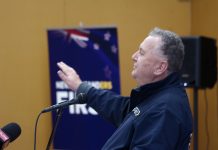
New Zealand First Leader Winston Peters is becoming increasingly provocative as he appears to be using his Foreign Affairs portfolio to attract domestic votes.
It’s not surprising.
Election year after election year he has sought to distance himself from any Government he is part of.
And that looks like what is happening again.
His rhetoric opposing Indian immigration and questioning our membership of the World Health Organisation has clearly been aimed at his populist base.
But the Prime Minister yesterday very firmly drew some lines in the sand, which indicated a more moderate approach by the Government.
Peters’ comments last week on the withdrawal by US President Donald Trump from the WHO sounded like an endorsement of his actions and begged the question as to whether he thought we should follow.
In a post last week on “X”, he wrote: “This is what happens when a bunch of unelected globalist bureaucrats are not accountable or responsible with worldwide taxpayers’ money. With the US withdrawing its membership, it puts into question the current state of the WHO, its effectiveness, and if our taxpayers’ money is being responsibly spent overseas instead of here at home.”
That was clearly pitched at the anti-vax lobby, which made itself felt for the first time at New Zealand First’s annual conference last September.
The anti-vaxers oppose the WHO’s international campaign for the use of various vaccines.
However, questioned yesterday on RNZ’s “Morning Report” about the comments Peters seemed to back off from his original post. His emphasis had become the way the WHO went about its job.
“There have been countless occasions where they’ve sought to make rulings or decisions without any reference to the democratic nations that comprise it, without any reference to their parliamentarians and any reference to the governments or the people of those countries,” he said.
“And we’ve had to rein that attitude back time and time again.
“That’s my point.
“Their job is to ensure that they are efficiently the servants of the taxpayers worldwide who subscribe and sustain them.”
Meanwhile, the Prime Minister Christopher Luxon told the same programme that New Zealand had no intention of pulling out.
He defended the work of the WHO in the Pacific, where he said it did incredible work and where New Zealand cooperated with it very closely.
Asked whether New Zealand’s membership of the UN and the WHO was in question, he said: “No, not at all.”
“Our challenge is to make them function better.
“There’s no doubt about it. They just haven’t evolved sufficiently. They haven’t disrupted themselves or innovated themselves enough to be stuck in a way of working that might have been how they were 10 years ago, but it’s not relevant for where we are today.
“So, we want more efficiency, more effectiveness from global institutions, but we want them renewed and strengthened and more effective. That’s really the drive.”
The next big chance for Peters to dog whistle his followers will be over whether New Zealand joins Trump’s Board of Peace, which has been described as an attempt to create an American rival to the United Nations.
Its constitution appoints Trump as its chair and allows him to appoint his successor.
Peters confirmed that New Zealand had been invited to join and that it would be discussed at the first Cabinet meeting of the year.
So far, 23 countries have joined. The only European country to do so is Hungary, and only two South East Asian countries, Viet Nam and Indonesia, have joined.
“Let’s have a look at it,” Peters said.
“Let’s wait and see what it all means.”
Though Peters might instinctively want to support Trump on this, a more measured response from the Ministry of Foreign Affairs and Trade might propose aligning any decision with that of close friends like Australia, Singapore and EU countries.
Meanwhile, Peters has formally indicated that New Zealand First will not vote in favour of legislation to implement the India Free Trade Agreement.
The issue here is his claim that it will dramatically increase the number of Indian migrants into New Zealand, while it offers the New Zealand dairy industry very little.
Though technically the India Free Trade agreement is the Ministerial responsibility of Todd McClay, the Prime Minister has repeatedly referred to it as central to New Zealand’s bilateral relationship with India.
Peter’s opposition would be fine were it not for the fact that he is the foreign minister.
Explaining to other foreign ministries that the Foreign Minister “disagrees” with his own foreign policy will require some challenging semantic gymnastics on the part of our diplomats.
All of this is consistent with the way Peters behaves every election year.
He seeks to distance himself from the Government even though he may be a part of it.
The former Finance Minister in the Ardern-Hipkins Labour Government, Grant Robertson, in his memoir, “Anything Could Happen”, described working with Peters in 2020, an election year.
“Our relationship with New Zealand First was at breaking point by this stage of the cycle,” he wrote.
“In many ways, the fact that we held it together to the extent we did is remarkable.
“Covid was taking up all the political oxygen, and Winston was sidelined.
“It felt like that on every issue he fought and scrapped and shifted and changed his position.
“We were over it.
“I told Jacinda there was no way I wanted to work with New Zealand First again.”
Here we go again.