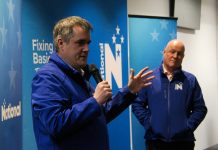
Labour’s conference over the weekend revealed a party whose main challenge now may be over-confidence.
They say their own polling puts them at 38 per cent and that the usual bump an Opposition gets during an election campaign will push them up to 40.
Couple that with the Greens hovering slightly above 10, and that adds up to a Labour-led government by the end of next year.
Perhaps the biggest boost has come from the disintegration of Te Paati Māori and the chance that none of their MPs will return.
Regardless, Labour was highly unlikely to have ever gone into government with them anyway.
The consequence of all this is that the 800-plus delegates who turned up for the conference at Auckland’s Waterfront Theatre could sniff the imminent prospect of a return to the Beehive.
But it won’t be easy. The party, and particularly its leadership, have still got some hard questions they will have to answer before they can hope to re-enter the Beehive.
Thus, the weekend had a very different mood from last year in Christchurch when supporters of the left-wing campaign for a wealth tax were handing out pamphlets and briefing journalists on their fractious debate with the more conservative capital gains tax supporters.

That is not to say there are no differences within the party.
Labour, after all, is a policy party and debate on every topic under the sun is almost mandatory.
Even Deputy Leader, Carmel Sepuloni, in a booming speech to open the conference, asked herself whether she and leader Chris Hipkins agreed all the time.
“Hell no,” was her reply to her own question.
Party President Jill Day was even more frank in her keynote speech.
“We are not a choir of identical voices,” she said.
“We are an orchestra, each bringing our own instrument and rhythm to create something beautiful together.
“Here in our party, the New Zealand Labour Party, our differences aren’t just tolerated; they’re not something we hide or something we use to pull someone down while lifting others up. They are celebrated.
That level of acceptance apparently prevailed during the remit sessions, which were closed to media but which veteran conference goers said were remarkable for their placidity.

There are, of course, the inevitable grumbles in the ranks about candidate selections, about head office imposing its will on some matters, and there is the ongoing debate about Palestine and the fact that the Māori Caucus’s definition of tino rangatiratanga might not be quite the same as that of the Pakeha members.
But over the years, Labour has shown that its greatest unifier is the possibility of victory.
Thus, the record turnout at the conference and in closed sessions reassured delegates that the money was starting to flow in.
What is remarkable about Labour’s renaissance is that it has happened almost despite itself.
Their party and caucus leadership will concede that they get their best social media response when they get stuck into National.
And so conference speeches were punctuated with a litany of complaints about the government and were all focused on how Government decisions were impacting the average Kiwi household.

“Christopher Luxon and Nicola Willis say they ‘get it’ – but they have no idea what life is really like for most New Zealanders,” said Finance Spokesperson Barbara Edmonds.
“No idea what it feels like to stand in the supermarket aisle, putting food back on the shelf because you can’t afford it.
“No idea what it’s like to sit at the kitchen table late at night, staring at the bills, wondering how on earth it’s going to add up this week.
“They are completely out of touch.”
Labour had two themes for the conference. It promised it would focus on “jobs, health and homes”, and then, in a reference to its proposed “Future Fund”, the speaker’s podium was emblazoned with the slogan “a future made in New Zealand.”
This strongly nationalistic slogan may be partly directed at stopping Labour voters switching across to New Zealand First, but Chris Hipkins placed it at the heart of next year’s election offering, and again, it was contrasted with what Luxon might want to do.
“The first step in Labour’s plan is the New Zealand Future Fund,” he said.
“It will back Kiwi innovation, support high-skill jobs, and ensure the wealth created here is kept here.
“Where Christopher Luxon wants to sell our assets, Labour will protect them.
“Where Christopher Luxon wants to sell us out to foreign investors, Labour will back our own people and ideas.
“Where he runs the economy for a few, Labour will build it for everyone.
“We’ll build an economy that lifts everyone – where young people see a future, businesses can grow here, and New Zealand’s success belongs to New Zealanders.”

Bold words, but the fine print is a bit more problematic.
Edmonds was emphatic in her speech that as Finance Minister she would “never waver in my commitment to fiscal responsibility.”
That will be a challenge given that its core policies of funding more Kainga Ora homes and health services would require a bigger fiscal spend.
And a 2026 Labour Government would already go into its first Budget in 2027 with one fiscal hand tied behind its back.
It has said that all the profits from state owned enterprises and other Crown entities would be reserved for the Future Fund.
That then leaves a question as to whether it would stick to National’s ultra-tight (possibly unrealistic) fiscal projections, which do not even make any allowance for inflation in future years’ operational spending allowances.
Hipkins was ducking that question yesterday.
“We will set out our targets under the Public Finance Act when we set out our fiscal plan, and that’ll answer all of those questions,” he told reporters after his speech.
“But we haven’t done that yet.”
Labour can expect a barrage from National demanding to know how its fiscal plans will add up.
They may also come under pressure over their relationship with Te Paati Māori.
The party’s newest Māori MP, Cushla Tangaere-Manuel, gave a lively presentation on why she believed Labour could win and hold all seven Māori seats at the next election.
“Labour is a place where Māori voices are amplified by our Pakeha, Pasifika and Tangata Tiriti whānau,” she said.
“Labour is a party with the depth of experience and heart, who understand Māori are not tidily packaged in pockets of society like Kohanga and Kura but are a part of the mainstream of Aotearoa.”
That was a direct shaft at Te Paati Māori, but she also, somewhat ambiguously, said she knew what she was up against in the Māori seats at the last election: “The promise of Mana Motuhake Māori – Māori Sovereignty. Aotearoa can achieve this with a Labour Government. “
Asked about this, Hipkins said (once again) that he would sometime in the future set out Labour’s policy.
“But I think what she was talking about with Tino Rangatiratanga, you would have heard her say she wants Tino Rangatiratanga for everyone, self-determination for everyone. “

Hipkins is an experienced enough politician to know that Labour is now entering a tricky zone where victory is possible but where the expectations of his supporters might exceed the willingness of middle New Zealand to accede to them.
He must know that he is soon going to have to start saying no to some of his supporters.
Barbara Edmonds seemed to acknowledge that reality in her speech.
“Getting the economy growing and balancing the books means we can’t say yes to everything – and I make no apology for that,” she said.
“Fiscal Responsibility must always come first.
“My job will be to make the hard, careful choices that grow the economy and give businesses and families the stability they need to plan.
“We won’t fix everything overnight, but as Finance Minister I will deliver the stability we need to build the future our country deserves.”
And that ultimately defines the challenge Labour will face over the next 11 months or so: how does it balance the aspirations of its members and supporters with the reality of presenting itself as a credible government?
That will be Hipkins’ test.