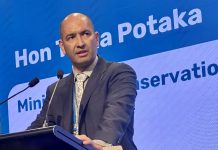
Conservation Minister Tama Potaka believes that one-third of the country, which is the Department of Conservation (DOC) estate, can bring Maori and Pakeha together.
He likens it to the way we all embrace the Maori Battalion or the Treaty of Waitangi as things that make us New Zealanders.
“The conservation estate and nature generally are the biggest magnets to pull New Zealanders together,” he told POLITIK yesterday.
“Bigger than anything else in this country, in my view.
“It’s something that New Zealanders believe in as our inheritance, but also the koha to future generations.
“And we are in the middle, and we’ve got a responsibility to make sure we respect that.”
So yesterday, he launched what he says is the biggest set of changes in over 40 years to the way the DOC estate is managed.
He said the changes were a counter to the “lock it up and leave” idea that DOC was simply there to preserve the estate.
But at the same time, he wants to see the estate become an integral part of economic growth in the country.

Most obviously, this is through tourism and particularly uses like the Great Walks or concessions that operators may pay for to have hotels, jet boats, or guided walks on the estate.
Lurking in the background, though, is another potential use of the estate, which is being promoted by Resources Minister Shane Jones, and that is mining.
Of particular interest is the DOC stewardship land, which was land DOC took over from Crown entities like the old Forest Service and Lands and Survey when it was formed in 1987.
Potaka says stewardship land takes up about nine per cent of the whole country.
Speaking in Waihi at the Oceana gold mine earlier this year, Jones said New Zealand had an inordinately large conservation estate of varying quality.
“A lot of that land isn’t considered to have special conservation or scenic values, but we do know that there are areas there likely to contain mineral deposits,” he said.
Potaka told POLITIK he resolved classification on the South Island West Coast for about two and a half of the national nine per cent.
“Ngai Tahu were very supportive, so were Ngati Waewae, Ngati Mahaki and others, of the decisions that I made,” he said.
“Council is very supportive; the community is very supportive.
“The only ones that didn’t like it were Forrest and Bird and the Environmental Defence Society. Maybe Shane wasn’t too flashy about it, either.”
But Shane (Jones )’s objections were that Potaka had not gone far enough, whereas the environmental organisations opposed what little liberalisation he had allowed.

Jones may have had a point.
The process for the disposal of Stewardship land (possibly for mining) that has been assessed as having no conservation value is torturous.
“After Departmental land status checks and relevant disposal tests, public notification, approval by DOC, survey and valuation, DOC either contracts a LINZ accredited supplier to complete the disposal process or, for some stewardship land disposals, a Statutory Land Management Advisor will complete the process,” The Regulatory Impact Statement on the proposed legislation says.
“A LINZ-accredited agent then confirms whether the land is subject to requirements under the Public Works Act (e.g. any offer backs to previous owners).
“Where there is a ‘right of first refusal’ in place through Treaty settlement, the land will be offered to relevant iwi or hapū unless an exception applies (e.g. if land is being sold to a former owner under the Public Works Act).”
Nevertheless, the Greens yesterday were ringing alarm bells, suggesting the new legislation would place conservation land at risk.
“Conservation land will be able to be sold off to mining companies and developers to make a quick buck under the changes announced today,” said Greens co-leader Marama Davidson.
Potaka said he is bringing certainty, less risk, and ambiguity to the situation surrounding stewardship land.
“And that’s what I’m bringing with these changes,” he said.
“Some of the stewardship land is literally a section in between two houses in Reefton. We should just sell it, sell it and then use the money to reinvest in conservation,” he said.
What he is trying to do with the stewardship land is part of an overall plan to put the focus on the real issue with conservation land and that is to protect its unique qualities at the same time as people are able to use it.
The Regulatory Impact Statement says economic activity on conservation land is regulated through management plans and national-level policies.
“These guide decisions on ‘concessions’, which authorise a range of activities, from small one-off events to larger projects involving construction of visitor and tourism infrastructure,” it says.
“Old plans and rules (and related decision-making) constrain economic activities that could have a range of benefits without negatively impacting our conservation objectives.”
The Statement points to management plans which it says are “outdated, bloated and sometimes contain contradictory rules.”
“Only around 20% of plans are current, and the overarching ‘general’ policies are now 20 years old. Plans contain overly rigid barriers to activity on conservation land,” it says.
“The system is one size fits all and inhibits modern regulatory approaches, even for low-risk and largely similar activities.
“There is ongoing ambiguity about how to give effect to Treaty principles, which has generated uncertainties around processing and decision-making.”
So Potaka’ s legislation will simplify the concession process.
“Not all concessions are the same; some should be just pre-approved and exempted, and that’s what we’re going to do, if Parliament agrees,” he said.
“Some need more attention and are a bit more complex.
“So simple ones, we’re just going to say pre-approved, exempted, then you create the space in the decision-making entity known as the Department to actually focus on complex ones, when what they should be focused on is killing deer and pigs and these critters that are eating all our native animals.
“Right now, they get too tied in to doing things that really, they should just let go.
“If it’s a drone, just let go if people want to use it, good. But if they destroy the place with the drone, like catching fire, they are responsible.”

The concessions are mostly money-earning activities, mostly aimed at tourists.
That is likely to mean higher fees for the concessions.
“The fact that we make only $60 million on 30% of the land just blows my mind,” he said.
“You and I know sheep farmers who make returns better than that
“We’ve got to do better. And if we don’t do better, then the species and the biodiversity will go backwards.”
One of the most controversial areas relating to the DOC estate has been the provision in a number of Treaty settlements, particularly Nga Tahu and Tuhoe, which gives the iwi a co-governance role over part of the DOC estate in their rohe.
“Each of those iwi that have reached settlement has got slightly different arrangements. Not one iwi is the same, and thank God for that,” said Ptaka.
“So this legislation goes a long way, 75 pages worth of amendments to uphold the simple redress in those settlements, and it provides for two years of discussion about complex redress, because some you can’t just push in through this legislation, which is in a compressed timetable.
“I think what’s important here is that we uphold simple redress, we have a talk about complex redress, and then those treaty responsibilities adjacent to settlements we’ve given more clarity and certainty, timetables.”
But Potaka also wants iwi to play a more constructive role in the granting of concessions.
“If DOC gets a concession application, get the feedback from the iwi in 20 or 30 days; don’t wait 200 days,” he said.
“No, go and get it, and if they want to participate, they can; if they don’t want to, they can’t. Sweet, they don’t have to.
“But what people don’t want is to be waiting months, weeks, years on end for feedback.
“You don’t like that, the Conservation department doesn’t like it, the applicant doesn’t like it, and actually a lot of the iwi don’t either; they want to just get on with it and do the mahi.
“And a lot of iwi are applicants for concessions too; they want to be on with them too.
“My cousin last week waited 10 years for a concession for a guided experience down the Whanganui River. Outrageous. 10 years.”
All of this is because Potaka is seized with the idea that the conservation estate should be at the centre of every Kiwi’s life.
“Conservation isn’t just lock it up and leave it, or one size fits all,” he said.
“We have to be a little bit more sophisticated, and that’s where I think we can make conservation absolutely fantastic and phenomenal again, because it is an endowment, and the one thing about nature in this country is the one thing that brings nearly all New Zealanders together.
“Most of us love something to do with nature, whether it’s the beach, the forest, the guided walk or the walks. We love getting into it.
“That’s why John O’Riddler, swimming from the Cape to the Capitol, was a phenomenal performance.
“It’s up there with Shackleton and Hillary because these people believe in the environment, but they’re also cognisant that we are interacting with the environment, and this legislation better governs and manages that interaction.”