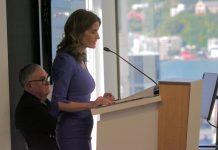
A long scheduled Treasury briefing yesterday turned into a revealing insight into how the Government might manage the economy if the worst comes to the worst over Trump’s tariff war.
Treasury provided a brutal summary of what went wrong with economic management during COVID-19 and why it would not be wise for the Government to repeat Labour’s big COVID-19 spend-up.
The briefing came while In another erratic move yesterday, Trump paused most tariffs at 10 per cent.
But he left China reeling by maintaining tariffs on its imports at 125 per cent.
That will impact all of the Asia Pacific, including New Zealand.
On Wednesday, the Asia Development Bank’s Chief Economist, Albert Park told reporters that Trump’s tariffs could see China’s growth slow by up to 0.9 per cent in 2026 with a similar downturn across the Asia Pacific.
The Prime Minister said yesterday that he was planning to phone leaders of both CPTPP countries and the EU to form a coalition to support free trade.
However, he dodged a question about China reflecting an unwillingness these days to be seen to be making political concessions to China.
At the same time a long-scheduled Treasury briefing on its upcoming Long Term Fiscal Statement devolved into a discussion on how to respond to economic shocks.
What was clear from that is that some serious lessons have been learned from Covid.
New Zealand spent $74.3 billion on Covid reliefs of one sort or another, much of which was funded by borrowing which sent net debt to GDP from 15.8 per cent to the current 44.3 per cent.
Treasury Secretary Iain Rennie reminded the briefing yesterday that meant keeping that ratio at a maximum of 50 per cent during normal times.
But Rennie’s first preference for relief during an economic shock is for the Reserve Bank to act.
“The international experience supports using monetary policy to moderate overall swings in economic activity in most circumstances,” he said.
“Compared with fiscal policy, monetary policy changes can be reversed more readily and can often be implemented faster.”
That conclusion explains Finance Minister Nicola Willis’s statement on Tuesday that one of the reasons you wanted a Government to be disciplined about spending was to keep inflation low and thus allow the Reserve Bank to reduce interest rates further.
Of course, the government will still face bigger demands on its finances during a shock because of what Treasury calls the “automatic stabilisers,” which is their jargon for a lower tax take and higher benefits payout that would result if growth slowed and unemployment rose.
“If you have a GDP shock of about one per cent, the automatic physical stabilisers will offset about half a percent of that, so half of the shock,” said Ben Gaukrodger, the Manager of Treasury’s Macroeconomic and Fiscal Policy team.
Nevertheless, Rennie did set out some options if a Government decided to implement some extra fiscal relief. However, what he said was as much a critique of what had happened during Covid as a roadmap for the future.
“Lessons learned from our response to recent shocks and cycles, including the Covid pandemic, have informed our assessment of the tools,” he said.
He said that specific lump sum payments could be quick to implement in relation to households, were inherently temporary, and could mostly be tightly targeted, but adjusting existing benefit, subsidy, and fee regimes for those affected but oonce-changed could be difficult to reverse.
Changes to taxes like personal income taxes or GST are usually not timely, can be difficult to target, and tax reductions were also hard to reverse.
“Wage subsidies can be effective if there is a clear exit strategy, and there is strong case for keeping people connected to their jobs,” he said.
“But it can be difficult to target those subsidies to specific sectors. regions or demographics.
“We don’t see varying government spending programs in general, whether on government consumption or investment, other than in direct response to a shock as being timely enough to counter shocks and cycles.”
That scepticism about increased Government spending during an economic shock extended to infrastructure programmes for which lead times were inherently long and variable.
“They used a phrase shovel ready projects. easier to conceive of in the abstract than in practice,” he said.
Treasury’s Chief Economic Advisor Dominck Stephens said it was an apt time to launch its briefing paper.
“We started writing this document well before tariffs were a potential issue, but with all of the volatility going on now, it’s actually a really apt time to launch this document so that we can draw on some of the key principles and apply them to the current circumstance,” he said.
“Maintaining flexibility of the economy is paramount, thinking about whether this is a temporary shock or not.
“Maintaining the viability of any support provided should be really careful to ensure that it’s not propping up firms that are no longer viable.
“If governments wish to provide some form of support, we’ve got practical lessons that we’ve learned on the various tools that are available. and have been informed by recent experience that can be applied going forward.”
The Government appears to be preparing itself well to handle whatever the Trump tariff crisis throws at it.
While Treasury evaluates economic policy options, the Ministry of Foreign Affairs and Trade gathers as much intelligence as it can from overseas and potentially affected businesses here.
As New Zealand has done many times before, it is seeking to take the lead in affirming free trade principles among as many countries as possible.

The Prime Minister was due yesterday to talk to leaders in the CPTPP and Europe to get them to affirm their support for free trade.
“It’s just making sure that if there’s opportunities where we can actually create an environment where free trade can take place, that would be or create an environment where we actually continue to remove the irritants and the frustrations around trade and get rid of those non-trade tariff barriers and a whole bunch of other things that we could be working on,” he said.
“Let’s at least explore that opportunity.”
What he is proposing sounds like the early stages of an alternative World Trade Organisation.
By late last night he had spoken to Prime Ministers from Malaysia, Viet Nam,Singapore and Ireland along with the Philippines and EU Presidents.
But conspicuously mssing from his list was China Premier Li Qiang.
Yet it is China that now holds the cards; it is the Asia-Pacific’s largest trading partner and the only economy capable of standing up to the US.
If this crisis has nothing else it has underlined that simple fact.