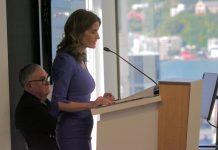
Prime Minister Christopher Luxon yesterday conceded that the election was “very, very tight”.
That is as near as you’ll get to him admitting he is worried.
And he should be.
Two of three polls published this week do not show National with a clear path to being able to form a Government.
Only one, the Roy Morgan poll, does, but even then it has the centre-right coalition with a bare majority of only two seats.
The Prime Minister’s “ho-hum” performance in the TVNZ leaders’ debate has only added to the uncertainty.
ACT Leader David Seymour will tell an audience today that the growing concern about the centre-right losing the election was one of the reasons for the dramatic falls in the New Zealand dollar in recent weeks.
While ACT are not yet moving much in the polls, they believe they are getting increasing support from former National supporters disillusioned by the party’s failure to control spending and its advocacy of the demerger of supermarkets.
“The ACT Party has stopped three new taxes in this government, a stamp duty, a bed tax and also a bank tax, but we haven’t been able to stop as much as we’d like,” he said.
“The ACT party saved a lot of money for the taxpayer, but haven’t saved as much as we would like, but that’s why we have elections.”
Seymour is promising to show where ACT would make spending cuts when he unveils the party’s alternative Budget this Sunday.
“We will show how we can get to surplus faster, balance the books with no new taxes, and issue strategic tax cuts on the things that make New Zealand a wealthier and better place,” he said.
Meanwhile Luxon continues to attack Labour over its promise to restore bargaining on the 33 pay equity claims that were ended in May 2025 when the Government legislated to stop them proceeding.
He claims this has left an $11 billion unfunded gap in Labour’s Fiscal Plan.
Hipkins last night in the TVNZ debate appeared to confirm that Labour would settle all 33 claims.
“We’re going to make sure that we give pay equity to Kiwi women who are on low wages, who have had that denied by this Government <” he said.
But Luxon is right, Labour’s fiscal plan does not provide for this.
Nor does the party’s policy say that is what Labour would do.
It says: “Labour will reinstate pay equity legislation in its first 100 days in office. The reinstated legislation will accommodate the previous work already underway, so women aren’t starting their claims from scratch.
“From 1 January 2027, care and support workers will receive an immediate pay rise of $4 an hour, worth around $8,320 a year, or $160 a week before tax, for an average full-time worker.
Labour has set aside $2.5 billion over five years to make those payments.
But the policy hints that those seeking relief from the 33 claims might be waiting a while.
“Future pay equity settlements are different,” it says.
“Pay equity is determined through negotiation, and announcing in advance how much has been set aside for individual claims would undermine that process.
“Future settlements will be funded responsibly through future Budgets as agreements are reached and their costs become clear.”
Ironically, this is similar to National’s policy, which has included within the PREFU a redacted contingency fund to pay for future pay equity settlements.
Basically, both parties are more or less on the same track.

That doesn’t stop Luxon.
He rests much of his case claiming that Labour will increase taxes beyond its capital gains tax on the lack of any funding in the Fiscal Plan for the additional pay equity claims.
“And that’s why Hipkins is coming after people’s money,” he told journalists yesterday.
“He’s going to do a capital gains tax; he’s going to expand it.
“He’s actually going to add more taxes because he’s going to borrow more and he’ll tax more because he’s spending more.”
There is not a shred of evidence to support Luxon’s claim, but he will be able to maintain it as long as Labour hints that it might settle the remaining 33 claims.
Finance Minister Nicola Willis didn’t help.
She admitted the Government was ready to spend a “secret” amount on additional pay equity claims.
“We’ve put money aside to deal with claims,” she told journalists.
“As you know, we’ve got three claims going through now.”
But whether she had put money aside was also a moot point, with Seymour telling his daily media conference that money for the pay equity claims was not funded at the moment.
National is on firmer ground when it attacks Labour over how it would find the $2.5 billion for the care workers’ claim.
It would use the money that National has budgeted for its Investment Boost programme.
It is an accelerated depreciation tax incentive that allows businesses to claim an immediate upfront tax deduction of 20% on the cost of eligible new assets, with the remaining 80% depreciated via standard rules.
The idea behind it is that it will incentivise businesses to purchase machinery and equipment that will boost productivity.
It was foreshadowed in a speech to the University of Waikato Economic Forum in 2025 by Treasury Secretary Iain Rennie.
He said our taxation of investment was uneven, which distorted investment choices.
“Such economic settings can discourage the acquisition of productivity-enhancing assets like machinery and equipment,” he said.
“This suggests that the policy responses are likely to include those that create an environment more conducive to firms making these investments.”
But Hipkins, speaking in the TVNZ debate, claimed it hadn’t worked.
“There’s no evidence to suggest that that’s what is actually happening,” he said.
“In many cases, those businesses were going to make those investments anyway.”
Unfortunately for Luxon, he then put his foot in it when he was extolling the success of the scheme by offering as an example the Coronet Peak ski field, which had sued it to purchase new snowmaking equipment, which had allowed it to extend its season.
One wit on the Prime Minister’s team dubbed his comments “Coronet Care”.
This is only the start of the fiscal debate.
ACT will produce its Alternative Budget on Sunday and National its Fiscal Plan on Monday.
But none of the ambiguities and claims and counterclaims would be necessary if the next Government picked up the proposal for a Parliamentary Budget Office, which would independently evaluate the parties’ spending and taxing proposals before an election.
But then, what would the leaders have to talk about?