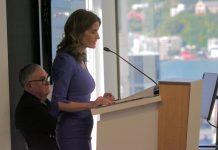
Prime Minister Christopher Luxon may well have begun to get his leadership back on track yesterday with an at-times unusually frank speech to around 200 party faithful in Wellington.
The speech was to one of the party’s regional Christmas functions, which usually don’t attract much attention.
Indeed, other regions have already had theirs without any media attention at all.
But media got notice at 5.30 on Friday that Luxon would be speaking at the event in Wellington’s Silverstream.
That was too much of a coincidence given that the week was beginning to be dominated by speculation about Luxon’s leadership.
NewstalkZB host Heather duPlessis-Allan hit the nail on the head when she wrote yesterday that people who attended the Air New Zealand party in Parliament last week said the possible rolling of Luxon was the talk of the event.
The two main Political Editors’ weekly columns over the weekend in the Herald and The Post both addressed Luxon’s leadership and the concerns about it.
Perhaps then, it was not surprising that Deputy Prime Minister Nicola Willis devoted the overwhelming part of her introductory speech to praising him.
It was notable that she also stood alongside him at a media conference after the speech.
The message was clear; they were a team.
The putative alternative to Luxon, Transport and Infrastructure Minister Chris Bishop received fulsome acknowledgement from both Willis and Luxon for his work on reforming the Resource Management Act, but beyond that, he was in the background.
For nearly eight minutes, Willis heaped praise on Luxon.
National had a leader who “carries his values, our values, with conviction, she said.
“We are led by someone who has the courage, who has the clarity to make the decisions that are in our nation’s interest,” she said.
“And boy oh boy, team, can I tell you, that is not always the easiest job.”
“So, it is my great pleasure to hear from the man whose vision you share for our country, who is leading us with such distinction, who has given us as individual ministers the empowerment and the space to lead our portfolios well, who has been to me a source of resilience, a source of friendship and a source of inspiration.”
Luxon then began what sounded like his usual stump speech with an attack on the previous Labour Government’s high spending and consequent debt.
But he cut it short after three minutes.
“Our attitude, National’s attitude, has been to get in, get stuck in to fix the basics,” he said, introducing the slogan “Fix the basics — building the future” which the party is obviously trialling for next year.
But before he focused on the future, he delivered an unusually frank account of the economic negatives which have dominated this year.
“The middle of this year was particularly challenging,” he said.
“Tariffs hit, confidence therefore crashed, and while conditions are looking brighter today, it has taken us months to climb out of that hole.
“The country rightly wanted answers, and so we looked at all the options.”
The result was a bold critique of previous governments.
“In recent years, the standard response in New Zealand to shocks like that has been what I call sugar rush economics,” he said.
“At different times, governments have tried to lift immigration considerably, engineer much higher house prices, or inject billions of dollars of additional spending, which ultimately gets funded through more borrowing.
“And the reality is that those choices intended to juice short-term economic activity have provided an illusion of growth, but often left us worse off over the long term.”
That reference to immigration was a prod at the Key/English government, which saw net migration climb from 10,100 in 2007 to a peak of 64,600 in 2016.
Nevertheless, there are concerns that the India Free Trade Agreement, which Luxon was talking up yesterday, could pave the way for increased migration from India.
He conceded that it would contain labour mobility provisions.
“We’re pro immigration,” he told journalists after his speech.
“We’re always pro immigration.
“We want to make sure that it’s always linked up to our economic strategy and also that we’ve got supporting infrastructure to support it.
“So you know, we’re constantly on the lookout for making sure that New Zealand’s got attractive settings to bring in people with the skills that we desperately need in this country.”
Luxon resisted the opportunity to make the kind of bold (and somewhat unrealistic) promises that dominated the last election campaign.
Instead, he offered realism.
“We are not going back to the sugar rush economics of more people and more debt to make up for every economic crack and wobble that we have,” he said.
“The country can’t afford another cost-of-living payment or another surge and then a crash in house prices.
“So we are sticking to the plan.
“And I understand that that’s hard going for some right now as we experience a challenging, but ultimately an essential pivot in the New Zealand economy.
“Now, our focus is actually on shifting the economic fundamentals of our economy; things like exports and savings and investment and a return to balanced budgets so that we don’t just come out of this at recovery, but we actually make ourselves much richer and make sure that Kiwis can get ahead.
“And in turn, that’s forcing, I think, a much bigger conversation about our future and the choices that we need to make so that New Zealanders actually have a shot at a much better life going forward.”
That is what his critics have been wanting to hear for much of the year: What is the plan?

And so came the surprise of the day; the promise to introduce in the next Government a substantial increase in Kiwisaver contribution rates.
It was the way it was pitched that was revealing.
Luxon had listed the way the Government was dealing with expanding trade overseas, infrastructure, and energy as responses to two big challenges facing New Zealand.
“The third big challenge that I think we have to confront is lifting our levels of savings and investment in this country,” he said.
It was the linkage between saving and investment that he emphasised.
“Smaller retirement balances present a challenge for the country as a whole as we rely more on investment from offshore for the capital that we need to fund the infrastructure, the startups, the housing that we need to grow our economy and create jobs and to lift incomes,” he said.
“And so if we’re serious about building the future, and I am, it’s time for us to increase our ambition for our individual retirement savings and for our collective savings that can be invested in some of the most transformational projects in our infrastructure pipeline.“
And so he proposed that if elected next year, National would continue to increase default contribution rates by 0.5 per cent after 2028, by which stage, in a move announced in this year’s Budget, they will have already increased to four per cent.
Now they would continue to rise at 0.5 per cent a year until 2032, to a 6 per cent contribution each from employers and employees, a combined rate of 12 per cent by 2032, matching Australia.
Luxon’s linkage of Kiwisaver to investment is a marked change from the way the increases announced in the Budget were presented.
Then the focus was entirely on the benefit to the individual on retirement..
“We’re growing the economy to create more jobs and more opportunities for Kiwis with more trade and higher productivity, spending your money carefully so we don’t burden our grandchildren with even more debt; ugrading the roads, the schools, the hospitals that you rely upon, and supporting New Zealand’s financial security for the long term with greater levels of savings and investment,” he said.
“I’m telling you, with National, New Zealand’s best days are ahead of us.
“More hope, more opportunity, and more ambition so that you and your family can get ahead.”
One speech does not rescue a Prime Ministership.
But if he can continue in this vein and focus on the future rather than the faults of the previous Government, he should at least freeze some of the muttering about his leadership.