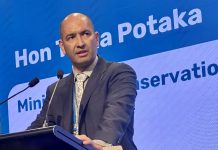
The Government is still under fire over its controversial Conservation Amendment Bill.
Already Conservation Minister Tama Potaka has had to back down over proposals to make it easier to sell Department of Conservation land.
Now, even the tourism industry thinks the Bill goes too far in emphasising economic development over conservation.
At the same time the Bill, like the resource planning legislation, shifts decision making from local communities to the Beehive.
It will surely be one of the ironic legacies of this Government that it has been one of the most insistent centralisers in recent years.
At the heart of the Bill is a new purpose for DOC.
It proposes that DOC’s function should include “to recognise the economic opportunities that arise from the use and development of land and other natural resources and historic resources managed by the Department, and to enable this use and development to the greatest extent practicable under this Act and other enactments”.
Conservation groups like Forest and Bird are never likely to accept that.
Forest and Bird’s acting CEO, Erica Toleman, told Parliament’s Environment Committee yesterday that the Conservation Act existed because Parliament recognized that public conservation land needed a clear legal framework focused on protection.
“It’s not an economic development statute and DOC should not be turned into an economic development agency,” she said.
But although Forest and Bird have some reservations about concessions allowing tourism activities on DOC land, the tourism companies who appeared before the Committee yesterday more or less agreed with her.
Milford Sound Tourism Ltd MSTL manages the visitor terminal, wharves, harbour operations, parking, and waste systems under a long-term DOC concession running through to 2050.
It is one third owned by Ngai Tahu and is funded by a levy paid by every passenger on a boat on the sound.
Over 950,000 tourists are expected at Milford over the next 12 months.
Milford Sound Tourism CEO Haylee Preston told the Committee she had concerns about the economic development function.
“Milford Sound Tourism Ltd supports responsible tourism and investment within the Conservation Estate, but only where it supports conservation outcomes and does not compromise areas of significant conservation value,” she said.
“We are conscious that the proposed new provisions broaden DOC’s role in enabling development and economic opportunities.
“There needs to be a clear guidance to ensure conservation remains the dominant consideration in decision making.”
RealNZ is another major player in South Island tourism running cruises on Milford Sound and the southern lakes including the Earnslaw on Wakatipu along with guided walks, whitewater rafting and also ownership of Cardrona and Treble Cone ski fields.
The company didn’t absolutely oppose the idea that DOC have an economic function but its Chief Conservation Officer, Paul Norris, said conservation must stay as a top priority for the Department of Conservation as its roles expands.
“The new clause gives DOC a much broader enabling role in economic development of conservation land,” he said.
“This is materially broader than today’s more limited purpose relating to fostering use for recreation and tourism where not inconsistent with their conservation.
“We support DOC being empowered to enable investment opportunities, carefully planned and appropriately managed use of development in parts of the conservation estate where it can enhance visitor experiences while supporting the long-term protection of New Zealand’s unique biodiversity.
“However, because it could also apply to use of conservation land for any purpose, not just the current settings of recreation or tourism, this expanded function may result in competing priorities.
“And so we recommend that guardrails are put in place to guide priorities and decision-making.”
The “long title” of the Bill currently reads: “The Conservation Amendment Bill amends the Conservation Act to streamline the management of land under this framework, better enable appropriate use of conservation land, and support more effective administration of conservation land.”
Norris suggested this should be rewritten to read: “To promote the conservation of New Zealand’s natural and historic resources.”
Even the Tourism Industry Aotearoa (TIA) which represents most New Zealand tourism businesses has reservations about the preference for economic development objectives in the Bill.
Its CEO, Rebecca Ingram said while TIA strongly supported the direction of the reform, they were concerned about the functions of DOC outlined in the Bill.
“Our first concern is the proposed function requiring the department to enable use and development to the greatest extent,” she said.
“We think the wording in the bill goes too far and potentially creates uncertainty about whether economic development is being elevated above conservation outcomes.
“Our preferred wording is simple; DOC should enable use and development to the extent consistent with conservation.
“Making this change will give DOC a clear and positive mandate to recognize and enable appropriate economic development and tourism opportunities.”
Forest and Bird were much more blunt.
“Government should remove the economic development objective and function from the bill and ensure that the new planning framework for conservation has conservation as its clear primary purpose,” said Richard Capie, Forest and Bird’s General manager of Policy and Advocacy.
Along with the concerns that the Government is trying to turn DOC into an economic development agency are concerns that it wants to bring some of the key decision making back to the Beehive.
Under the existing legislation In New Zealand, the New Zealand Conservation Authority (NZCA) and regional conservation boards act as independent statutory bodies.
They advise the government, approve key management strategies, and represent the public interest in protecting public conservation lands, national parks, and natural heritage.
The Bill proposes imposing a National Conservation Policy Standard over the top of the Authority and the Boards and requires that they need the approval of the Minister for what they then do.
Forest and Bird are concerned.
“New Zealanders want their local voices heard,” said Capie.
“So, taking local voices and independent checks out of the conservation system is something that we strongly oppose.
“Government should retain meaningful decision-making and the oversight roles of the conservation boards and the New Zealand Conservation Authority, rather than reducing them to be advisory bodies.
“Ministerial powers need to be constrained, and they should be constrained by clear statutory criteria and conservation purposes.
“That avoids political flip-flopping, decision-making made in political cycles, and therefore provides certainty and clarity, not only to the conservation system, but to businesses and commercial operators who want to operate within conservation.”
Erin Vercoe, general counsel for RealNZ was also concerned about the aggregation of Ministerial power.
“A lot of the decision-making has been left in the Minister’s hands, and the role of the Conservation Authority and Conservation Boards has been reduced back to an advice and consultation role,” she said.
“We think that possibly goes a little bit too far.
“We think those bodies in particular bring really deep subject matter expertise and they also have a really good community perspective, which we think is really valuable.
“As a minimum, we would say they should have a formal recommendation role but also support the approval role that they currently have.
“We also think the right to be heard on submissions is important, especially for the National Conservation Policy Statement, area plans, et cetera, not just the right to make written comments, but actually to come and talk to people as well, and we found that in the past that’s actually elicited some really great insights for us in terms of local concerns about us operating on conservation land and how we might best deal with those.”
Forest and Bird’s senior environmental lawyer, Tim Williams was worried about the implications of bringing decision making back to the Beehive.
“When you put too much power in the hands of the ministers, it just results in shorter term decision making and essentially decision making that isn’t focused on conservation,” he said.
“So having independent expert bodies that can direct actions towards the purpose of the act is a really important feature.”
That is, of course if the purpose of the Act prioritises conservation.
This legislation is a real clash of culture.
It is part of the Government’s “Building the Future” emphasis on economic development and like the resource management legislation there sems to be an underlying fear that unless decisions are made in the Beehive, local people will prioritise other things like the environment or conservation rather than the economy.
That is one of things that the Opportunity Party has been exploiting in its campaigning.
The Government has already had to back down once in this Bill over the disposal of DOC land proposals; it would not be surprising if the intensified politics of the election campaign lead to some more changes yet.