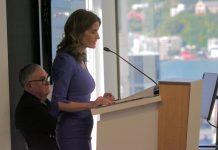
The theory is that the Reserve Bank will have kickstarted the economy yesterday with its dropping of the Official Cash Rate to 3.0 per cent.
The Bank made the move despite forecasting inflation for the current quarter to be three per cent.
But it is “looking through” that figure to forecast it falling to 2.2 per cent by the end of next year.
That fall will be what powers what will probably be two further cuts to the OCR before the election.
That is the kickstart the Finance Minister is looking for, but as the Bank’s Governor and Chief Economist conceded, just how extensive that kickstart will be and when it might happen is far from certain.
So though the Finance Minister was yesterday celebrating the Bank’s move and claiming some of the credit for it, just how much the move will help revive the Government’s flagging fortunes is another matter.
Judging by yesterday’s Reserve Bank press conference about all you can say is that the jury is out.
If there was a word that punctuated the press conference from Acting Governor Christian Hawkesby, it was “uncertainty”.
“Looking forward, there are upside and downside risks to the economic outlook,” he said.
“Cautious behaviour by households and businesses could further dampen economics.
“Alternatively, the economic recovery could accelerate as the full effects of interest rate reductions flow through the economy.”
That uncertainty played out during the deliberations by the Bank’s Monetary Policy Committee, which for the first time was split 4-2 on the final decision.
“We had some members emphasising the downside risks, other members emphasised the upside, and others seeing the risks as balanced,” said Hawkesby.
“And so I think that’s a key outtake and it illustrates the uncertainty that we’re in at the moment.
“The argument for a more modest cut, no cut or a more moderate cut was around the fact that, yes, we’ve seen economic activity stall in Q2 (Quarter Two), but that could be temporary.
“That could bounce back, and we are already seeing some indicators from July quite healthy.
“Also, a consciousness that inflation is near the top of the range, and so there’s a risk that inflation expectations ratchet up and make our job harder.
“On the downside, the risk is really around the slowdown in Quarter Two to being more persistent and really needing more of a jolt and more aggressive action from us to brighten the economy.”
Though Reserve Bank Governors with their preference for caution might intuitively embrace uncertainty, Cabinet Ministers feed off its antonym, certainty.
Thus, the Finance Minister yesterday was proclaiming the Reserve Bank decision to be the dawn of a new economic age. She was particularly enthused by the Bank forecasting that the Official Cash Rate could fall a further half a per cent to 2.5 per cent by the first quarter next year.
She cheerfully ignored the fact that the Bank is then forecasting the OCR to slowly rise back to 2.8 per cent by mid-2027.
“The future track has been lowered,” she told Parliament.
“The monetary policy committee is now signalling two more OCR reductions this year, which would bring the cash rate to 2.5 per cent.
“That is more than the market expected, so I would expect both floating and fixed interest rates to now fall as a consequence.
“People have been calling for more stimulus in the economy. This is more stimulus.”
Hawkesby was willing to give Willis some of the credit for the decision to reduce the OCR.
“We did discuss the fiscal outlook,” he said.
“It is one where government spending as a proportion of all activity is falling through our projection period, so in that sense it is part of reducing inflation pressures.”
Media: “So it does help?”
Hawkesby: “Yes”
The bigger issue, though, is just what the impact of the OCR drop will be.
Experience this year has shown that a drop in the OCR and in mortgage interest rates does not necessarily lead to the kind of immediate pickup in economic activity that Willis is hoping for.

“Going forward, we would expect lower interest rates to show up in things like investment and residential investment and consumption, and what industries are leaning into those parts of the economy, and that would be retail, et cetera,” said the Bank’s Chief Economist, Paul Conway.
Assistant Governor, Money, Karen Silk, suggested that the power of interest rates to impact the economy might not be as great as some imagined.
“It’s not just interest rates that will drive the outcomes in some of those sectors,” she said.
“Paul is certainly talking about the ones that are more interest rate sensitive.
“There’s no doubt about that, but if you think about housing in Auckland, population growth is a significant impact as well on what’s happening with housing in the Auckland region.”
The Bank believes that house prices are critical in determining economic activity.
“Normally we’d expect house prices to be increasing a bit more at this point in the cycle, but they’re not,” Conway said.
“We’re not expecting them to increase a great deal over the coming 18 months or so.
“And when you look at household consumption, it’s very highly correlated with changes in what’s going on in the housing market.
“So there’s a bit of an open question there.
“Can the New Zealand economy grow without that sort of wealth effect coming through the house?”
Both Silk and Conway rejected the argument that house prices were simply a function of interest rates.
Silk said low working-age immigration was having its own impact, while Conway said there were limits to what the Bank could do to get the economy moving.
“Population growth is very low, and house prices and population growth have been the key drivers of economic growth in this economy for decades, so it really gets us back to the issue of productivity growth,” he said.
“If we want to get growth going forward in the long run, then it’s about improving productivity in this economy.
“And monetary policy is not the instrument for that.
“We’re about controlling demand to keep inflation low and stable. There’s only so much we can do.”
For all that, the Bank is continuing to forecast a recovery in the economy next year.
But it’s complicated.
Those parts of the economy linked to primary exports are doing well; those parts focused on demand within Auckland and Wellington are not.
“At the moment it feels like a two-speed economy,” said Hawkesby.
“What we’d emphasise is that it’s always a multispeed economy. There are always different sectors, industries, and regions that feel different depending on the environment that we’re in.
“So, it’s not unusual that we’re in a multispeed economy, but it is very pronounced at the moment between Auckland and Wellington and the rest of the country.”
And that is the political problem.
Seventeen of National’s 48 MPs come from Auckland.
If the interest rate drop doesn’t kickstart the economy there, then what?
Does the Government try to stimulate more immigration, or does it take up the suggestion from its former leader, Simon Bridges, and throw some money at the city?
Perhaps that was the most important message from the Reserve Bank yesterday: that the Beehive cannot rely on the Bank to save it.