Forest and Bird, the Labour Party and luminaries like Helen Clark have mounted a full-on campaign against the Government over its proposals to revamp the Department of Conservation. (DOC).
Central to the Government’s proposals is an overall theme of trying to restructure the funding for DOC.
In part, this will come from stepping up tourism revenues and other economic activities on the DOC estate, and in part from selling off some land, which will not only bring in some immediate revenue but also help reduce costs.
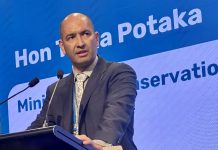
It is an emotional issue and one that has Conservation Minister Tama Potaka vigorously defending the Government’s proposals.
He says simply that DOC owns too much land with low conservation values like Wellington’s Met office and that allowing DOC to earn more will provide more funding to properly maintain the high quality land it does own.
The centre left have been out in force attacking the proposals and the issue is becoming a major political row.
Former Prime Minister Helen Clark has called the proposals an “outrage” and a “scandalous and destructive attack” on the country’s natural heritage.
The current Labour MPs have been equally dismissive.
“Tama Potaka wasn’t made Conservation Minister to put a price tag on our public conservation estate,” Labour conservation spokesperson Priyanca Radhakrishnan said.
“His job is to protect these places for future generations. Instead, he’s paving the way for their sale.
Forest and Bird have fired up the debate by issuing maps which show land that could be eligible for sale.
The maps (correctly) show that land could cover as much as 60 per cent of the conservation estate.
But the operative word is “could”.
Conservation Minister Tama Potaka argues that there are substantial protections embedded within the amending legislation to prevent the kind of wholesale disposal that Radhakrishnan is talking about.
“If you understand the history of the conservation land, a lot of that land that was put into the conservation estate was of little or no conservation value,” he told POLITIK.
“So a great example of that is the Met Service building up on Bolton Street that ultimately ended up in the conservation estate.
“Now, there’s no way that that’s got high conservation value.
“It’s something that we look at and say that’s consuming our staff time, that’s consuming our resources, and actually we should think about disposing of that.”
That is an obvious enough example, but the Bill allows DOC to go further and would enable it to sell all land other than National Parks and wilderness areas. nature reserves, scientific reserves, ecological areas, sanctuary areas, marine reserves and wildlife sanctuaries, as well as foreshore areas, while certain lands subject to Treaty of Waitangi claims and settlements remain legally protected from sale.
DOC owns and manages approximately 30% to 33% of New Zealand’s total land area, which equates to roughly 8.5 million hectares.
Potaka’s Bill leaves 60 per cent of all DOC land potentially for sale, and Radhakrishnan claims that would leave areas like Conservation Park, Cathedral Cove, the Remarkables and the Catlins at risk of ending up on the market.
Potaka disputes this.
“This is not about selling off land, there’s no plan, no program to sell off land,” he said.
“If you were to go into disposing of land here’s a process, you have to follow, you’ve got to engage with iwi and Māori groups, you’ve got to engage with previous landowners, public works regime, you got to engage with administering bodies who might be looking after the land and then you’ve got to go to a public engagement and notification process in order for a recommendation from the Director-General to then go to the Minister to consider a whole range of matters before a decision is made.”
The Amendment Bill provides that for conservation land to be eligible for disposal, the Minister must find that the land is not important for protecting threatened species or ecosystems, and its native plants or wildlife habitats are not the best examples of their type in that district.
The Minister can only consider a sale if the Director-General’s report explicitly recommends it. The Minister must weigh several factors, including public access, recreational value, biodiversity significance, historic resources, and financial implications.
Given those conditions, Potaka believes that Forest and Bird have been misleading with their campaign.
“The forest and bird community and organisation have been spurious and scandalous, mischievous and dangerous in suggesting that this government intends to sell off up to two-thirds of the conservation estate,” he told POLITIK.
“Nothing could be further from the truth, and certainly if that was the case, I’d be the first person to jump up and down, do a Haka and say no, stop, don’t do anything.
“What we are doing is being very clear: there’s a whole bunch of land, and there is no way we’re going to sell it.
“Most of the land. The vast majority, there’s no way we’re going to sell it, but there are small parcels around that we have to have a process with very clear, stringent tests, where we can follow that process and get to a ministerial decision.”
There is, however, another aspect to the Amendment Bill which also worries Forest and Bird, and that is a redefinition of the purpose of DOC.
The Department’s Regulatory Impact statement on the Bill says: “The Cabinet directed the Minister of Conservation to amend the purpose statement of the Conservation Act 1987 (the Conservation Act) to ensure that wider reforms to the conservation land management system enable greater economic development on conservation land.”
This is new.
The 1987 Conservation Act is almost entirely focused on conservation and is much more cautious about economic development.
It says the role of DOC should be to “promote the benefits to present and future generations of the conservation of natural and historic resources generally and the natural and historic resources of New Zealand in particular.”
And: “To the extent that the use of any natural or historic resource for recreation or tourism is not inconsistent with its conservation, to foster the use of natural and historic resources for recreation, and to allow their use for tourism.”
But Potaka argues that DOC needs more funding, and allowing more commercial activity on the estate is one way of achieving that.
“I’m calling on New Zealanders to support the idea of generating more revenue through access charging international visitors into some areas, where we could probably make tens of millions of dollars to enable funding to be reinvested in biodiversity,” he said.
“What we are very clear about is that we have done an amazing array of initiatives over the last month, as an example, Predator Free 2050 Auckland invested money through that.
“Another example is the Marine Protection area off the Timarū, Otago and Southland coast, increasing marine reserve protection by 50%, the biggest increase of marine reserves ever.
“The predator-free work down in the South Island, we’ve just committed nearly $15 million to shooting possums, goats, mustelids and rodents.
“And finally, the Wilding Pines, for which $39 of the $109 million actually came from the Department of Conservation.
“I think you’ll see that we’re about pragmatic conservation.”
The fear is that DOC will simply become a tourism department, administering and charging for experiences on the estate.
“It’s a balance, but we have got some outstanding tourism offerings right now in the conservation state, whether or not it’s guided walks or jet boating or skiing or even iwi, Māori-driven experiences like what Ngai Tahu does down south and others,” said Potaka.
“So there is a good balance that we need to strike, a careful balance, so that we don’t go overboard with economic development.
“That’s not what this is about.
“The primary purpose of conservation is conservation.
“It’s not about making money, but we need to make sure that DOC has got flexibility to keep on facilitating economic development within the parameters of conservation.”
Potaka has got some powerful and well-organised critics of his plans.
And he will need time to show that more revenue means higher-quality conservation.
That is his goal and the only way he will be able to quieten the critics.