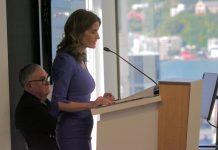
The proposed high noon debate over the level of Government spending between the Finance Minister Nicola Willis and her National Party 1990 – 1993 predecessor Ruth Richardson was, by last night, in danger of descending into farce.
POLITIK is unconvinced as to who proposed that the moderator be New Zealand First Leader Winston Peters, but by last night, Richardson was rejecting the idea while Willis was amenable.
However, Willis’s office was denying that she had proposed it, as were the Taxpayers’ Union, which Richardson chairs.
One source said the idea came from NewstalkZB political commentator Barry Soper.
Instead, there were suggestions that the economist Cameron Bagrie might chair the debate if and when it happens.
POLITIK also understands there is no agreement yet on a venue or a date.
Regardless, the fact that Peters, who has publicly been slagging off Richardson for the past 35 years and who, privately, is said to be no fan of Willis, could even be considered, suggests that this is not likely to be seen as a heavyweight economic showdown.
Instead, it was looking very much like a political event, possibly even a stunt.
But within the fog of confusion and contradictory press statements, there is a fundamental issue, and that is whether the Government is on an unsustainable spending path that it will sooner or later have to rein in.
Richardson concedes that the situation facing Willis is different to that she faced after the election in 1990.
In the five months after the last Labour Government Budget, the fiscal situation had dramatically changed.
This was before the Public Finance Act made regular fiscal projections mandatory, and the first time the new National Government knew of the situation was after they were elected.
Between July and the election in October, what Labour had projected to be a small surplus had turned into a $1 billion deficit.
Over and above that, the Government was forced to bail out the state-owned BNZ and the Development Finance Corporation, which absorbed another $700 million.
In inflation-adjusted terms, that would equal $3.76 billion today.
That deficit was forecast to blow out (in inflation-adjusted terms) to nearly $10 billion by 1992.
The late Prime Minister Jim Bolger was horrified.
In May, he told POLITIK he felt betrayed.
“It was amazing. It was just a great big lie, and he (Labour Prime Minister Mike Moore) knew it was a big lie,” Bolger said.
The immediate response was devastating to a Prime Minister who had campaigned on providing a “decent society”.
A week before Christmas, Richardson announced an economic package that included across-the-board benefit cuts, the abolition of the family benefit, a cut in subsidy for visits to the doctor and some prescription charges increased.
The projected financial deficit for 1990/91 was reduced from $1, 019 million to $691 million.
Then, in the infamous “Mother of All Budgets” the following year, Richardson imposed a restructuring of health funding and significant changes in the funding and charging for public housing; higher levies on petrol and wages to fund ACC reforms, and higher alcohol and tobacco excise taxes.
But perhaps the biggest political backlash was over something Richardson did not do; Bolger had persistently promised through the election campaign that National would abolish a surtax on national superannuation that had been imposed by Labour.
“No ifs, no buts, no maybes,” he frequently told election rallies.
Instead, the fiscal situation meant there was a freeze on pension rates and a gradual lift in the age of eligibility from 60 to 65, and the surtax stayed.
There was a backlash from within the National caucus, with Winston Peters being fired from Cabinet and MPs Hamish MacIntyre and Gilbert Miles leaving the caucus to form their own party, while from within, Michael Laws kept up a constant public criticism of Richardson.
All of this added together created the myth of “Ruthanasia, and it is that myth that Willis wants to debate.
But Richardson argues that the situations are different; that whereas she confronted a crisis and had no choice but to take the actions she did, Willis can avoid such a brutal response if she starts trimming government spending now.
“We were facing a huge crisis that called for a very substantial response,” she told POLITIK yesterday.
“But what we’ve had over the last few years, with COVID exacerbating it, is just a lot of drift.
“And COVID took us to high tide mark, and we’ve really not receded from that.”
Willis’s 2025 Budget forecast the deficit to fall from its current $15.6 billion level to $3 billion by the 2026 Budget.
But in September, the Treasury produced its Long Term Fiscal Statement, which showed the country remaining in deficit for the next 40 years.
Richardson argues that another “Mother of All Budgets” can be avoided.
She said that when governments refused to act early, the options narrowed and the eventual adjustment became far harsher.
Richardson is saying no more than Treasury has been saying in a persistent series of briefings throughout the year.
Treasury Secretary Iain Rennie was repeating the warnings before a Select Committee a fortnight ago.
“Going forward, New Zealand governments face a much more difficult set of both economic and fiscal challenges than governments have faced in previous decades,” he said.
“Domestically, we face a combination of a very significant structural fiscal deficit in the near term.
“So essentially, the current explicit and implicit commitments that the Government has made to the New Zealand community are not fully funded.
“And that problem continues to escalate. Into the future, largely as a result of demography, but we also face, as I’ve talked about in the committee previously, a range of other shocks, whether they’re climate related, public health, etc.”
Rennie particularly pointed to increases in defence spending as an area that would impose extra stress on the Government accounts.
Rennie has argued that there is no silver bullet that will fix the situation; that it will require a restraint on spending and, quite possibly, revenue measures.

When the OECD addressed the problem last year, it was more explicit.
“Raising revenues should be first achieved through broadening the tax base and reducing distortions before raising rates of existing taxes,” it said.
“There is a need to reduce distortions to household choice of asset allocation.
Shares, land and owner-occupied residential property are tax-favoured.
“Most capital gains from shares, owner-occupied residential property and land are not taxed.
“To ensure the tax system is not overly distorting saving and supporting broader growth, capital gains taxation reform should be done as part of a wider review of tax settings.”
But at the same time, the OECD said ageing-related expenditure was rising quickly, and pensions were starting to be a major driver of new expenditure.
“Many of the reforms needed to sustainably tackle ageing-related expenditure need to be introduced gradually (e.g., increasing the retirement age) and take a long time to have an effect (e.g., reforms to raise productivity).
“This argues for acting now despite the relatively benign outlook for public debt until 2030.”
Willis would seem to see the debate as a chance to portray herself as a much more sympathetic figure than Richardson.
Her plan appears to be to present a binary choice. Either go along with her gradualism or endure another “Mother of All Budgets”.
The argument will be made all the more focused by the publication on Tuesday of the Half-Yearly Economic and Fiscal Update, which will undoubtedly enlarge on the views presented by Rennie to the Select Committee.
Ultimately, Willis is going to need to produce a credible path to reduce the structural deficit at the same time as she does it without repeating the “Mother of All Budgets.”