Yesterday was absolutely not an election-year Budget. Apart from a $450 million war chest set aside for “temporary targeted support” if the fuel crisis deepens, there wasn’t a single headline-grabbing bribe in sight.
Instead, Finance Minister Nicola Willis stuck strictly to the script National has been reciting ad nauseam since taking power in 2023.
“This budget is about New Zealanders… but only if we stick to the plan,” Willis told the Budget lockup, delivering her ultimate warning: “Don’t put it all at risk.”
In case anyone missed who represented that “risk,” the Budget documents were weaponized with constant comparisons to the 2018–23 Labour era, shouting about an 47 per cent surge in spending.
With that ghost exorcised, Willis unveiled another four years of austerity, triumphantly claiming a projected surplus for the 2028–29 fiscal year—a full twelve months ahead of December’s grim forecasts.
But then came the classic political asterisk: “I do want to say, of course, numbers can always change.”
They certainly can. And given the volatile crisis in the Middle East, those triumphant figures are sitting on a geopolitical powder keg.
Treasury faces an almost impossible challenge here.
To get the numbers right, it needs to be able to forecast accurately when the conflict will end and when, after that, things in the oil market get back to normal.
That means forecasting accurately the mind and actions of President Trump.
Optimism seems to prevail.
The Budget Economic and Fiscal Update (BEFU) published yesterday by Treasury says that the oil futures market prices on April 21 implied that prices would gradually ease and return close to the pre-shock level over 2026 and 2027.
But: “Risks to these forecasts are weighted to the downside,” the BEFU says.
“The relatively benign impacts on the economic and fiscal position from the oil price shock are predicated on the assumption that oil prices will reduce over the coming months.”
So everything hangs on the Middle East returning relatively quickly to normal.
Treasury therefore sees growth stalling this year and next but bouncing back in 2028. That contrasts with its forecasts last December for the Half Yearly Economic and Fiscal Update which had the bounceback next year.
| 2026 | 2027 | 2028 | 2029 | 2030 | ||||||
|---|---|---|---|---|---|---|---|---|---|---|
| Year ending 30 June | HYEFU | BEFU | HYEFU | BEFU | HYEFU | BEFU | HYEFU | BEFU | HYEFU | BEFU |
| Real production GDP (annual average % change) | 1.7 | 1.2 | 3.4 | 2.3 | 2.6 | 3.2 | 2.5 | 2.7 | 2.5 | 2.5 |
| Unemployment rate (June quarter) | 5.3 | 5.5 | 4.8 | 5 | 4.6 | 4.5 | 4.5 | 4.4 | 4.3 | 4.3 |
| CPI inflation (annual % change) | 2.4 | 4 | 2.2 | 1.6 | 2.1 | 2.1 | 2.0 | 2.1 | 2.0 | 2 |
| Current account balance (annual, % of GDP) | (2.8) | -4.1 | (2.8) | -3.5 | (2.7) | -2.9 | (2.6) | -2.6 | (2.6) | -2.5 |
| OBEGALx ($billions) | (13.9) | -11.937 | (10.4) | -11.441 | (5.1) | -4.276 | (0.9) | 2.585 | 2.3 | 6.115 |
They are picking unemployment to peak this year at 5.5 per cent and then to drop back to 5 per cent next year.
They see inflation peaking at four percent this year, which is nearly double what they forecast last December, but then they are picking it to tumble to 1.6 per cent next year.
But the big positive difference is that the OBEGALx measure of the surplus/deficit goes positive in 2029 in contrast to last December when Treasury were not forecasting that to happen until 2030.
Those figures are not the same as figures from the Reserve Bank yesterday.
The Bank is expecting inflation to go to two per cent by March 2028.
However, the Bank is more optimistic about growth rates post-2028.
All this variance just underlines how tricky forecasting is at present.
In an unusual move, it has added a sort of “stop press” to the BEFU with an update covering the period since the document was formally signed off on April 24.
“Rising input costs, lower real household disposable income and heightened uncertainty are likely to dampen activity over time,” the addendum says.
“Overall, these factors suggest the central forecast may understate inflation pressures while overestimating near-term growth, with risks skewed to higher inflation and weaker activity.
“Should these factors play out, the fiscal position could marginally weaken in the near term, although this is unlikely to have significant implications for the expected return to surplus in the later years of the forecast.”
However, there are other numbers that might change.
Willis has not included the future health funding path in the forecasts, and that could run to billions of dollars.
She said that already, health spending was costing $17,000 a year per household.
“When we came to government, we committed to multi-year funding uplifts for health, in which we set out in advance how much funding would increase for health at each budget we delivered, and we’ve delivered on that commitment,” she told the lockup.
“What we haven’t yet done is set out the funding path for the next three budgets.
“So that is not yet accounted in the numbers.
“We do intend to do that ahead of next year’s budget, so you will expect to see many billions more invested in the health service in the coming years.”
But how Willis might achieve that when she has set the annual Budget operating allowance at $2.4 billion out to 2029 has not been explained.
Logically, it would seem to point to more big spending cuts in the next three Budgets.
The only alternative would be to forget about returning to surplus in 2029.

Health is one leg of the fiscal double of the two big expenditures, made much bigger by the baby boomer generation entering old age.
The other leg is New Zealand Super. And here the problem is not the Middle East but the politics of the coalition.
“The annual cost of New Zealand superannuation is already rising sharply,” she said.
“This is not a problem for tomorrow.
“It is something happening right now.
“That bill has increased from less than 20 billion in 2023 to more than 30 billion by 2030.
“Next year alone, it will increase by 1.8 billion, and that debt load is almost twice as heavy as it was just a decade ago, and that is more than four times this year’s operating allowance.”
And then came a withering attack on New Zealand First.
“I’m conscious there are others to my left who might take a different view, that actually in the absence of doing anything about our settings for the future, we will be committing a huge act against intergenerational equity,” she said.
“That is to say that governments who put this off forever are essentially committing to taxing people my age and younger more, and to paying them less superannuation in the future.
“At some point, a responsible government needs to propose gradual, sensible, moderate changes that are well forecast for New Zealanders, and that ensure that everyone can look forward to universal superannuation knowing we can afford it without higher taxes.
“And my party intends to have a policy on that on the campaign trail.
“I put it to you, that parties who say they won’t do anything about it are prepared to rob everyone in this country under the age of 50 for their own political expediency.
“I reject that approach.”

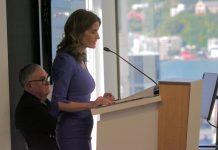
Interestingly, the New Zealand First Minister to the left on the podium, Shane Jones, made no attempt to defend the New Zealand First policy, which has always been most closely linked to leader Winston Peters.
“I’ll defer that question to my Rangatira. I think you’ll hear lots of observations from us when we get closer to the election,” he said.
That left one commentator wondering whether Jones was being loyal or disloyal to Peters.
And there was ambiguity also in a Jones response to a question about the new levy being imposed on banks and other deposit takers.
Ostensibly, this is a sort of user-pays measure designed to cover the costs of the Reserve Bank’s prudential supervision of the financial sector.
Willis said it would be less than one percent of the total profits of the big four banks alone.
But the fact she chose to express it that way gave the game away; this looks very like the first attempt to nobble the big four banks’ big profits.
The banks are a popular target this election year, and NZ First leader Winston Peters has proposed buying back the Bank of New Zealand from its Australian owners.
“I thought it better not to say anything about a banking tax. We’ve said enough about banks recently,” Jones replied to a question at the lockup, which, again, hardly sounded like an endorsement of Peters’ proposal.

But coalition politics are proving to be an obstacle for Willis.
“I have continued to look at how banks are taxed around the rest of the world and continue to examine those options,” she said.
“In terms of the options that I have looked at so far, those were not options that were agreed to by all parties in the coalition.”
That was a reference to ACT leader David Seymour.
“I strongly believe the government has a position that we don’t introduce new taxes beyond what is fair and already applied to others,” he said.
Nevertheless, the big question that hung over the lockup and the BEFU was the credibility of the forecasts.
“The forecasts are not my forecasts, they’re Treasury’s independent forecasts,” said Willis.
“So, they have presented their best professional judgment, as they have for many years, and they represent their prudent central scenario.
“The documents we’re publishing today do outline a downside scenario and an upside scenario to give you a sense of what could change with different unfolding patterns for the conflict.
“Interestingly, what that shows you is that even in the downside scenario, the Government’s prudent fiscal plan means we would still deliver a surplus in that target year.
“It is the case that forecasters will have a range of different assumptions, but I have confidence in Treasury’s forecasts, noting they must always be caveated.”
The forecasts are shaky, but from a political point of view, that risk is one the Government is willing to take.
It is consistent with the campaign script that it ran into the last campaign with; Labour is an irresponsible economic manager, National is not, and it is only through National’s discipline that we can eventually reach a state of moderate prosperity.
Or as Willis put it: “I’m proud to say that new spending in each of the three budgets I have delivered has been lower than the operating allowances set ahead of those budgets.
“We’ve kept our word.
“Contrast that with the previous Government, which blew its operating allowance in all six of its budgets and, in addition, spent considerable amounts outside those allowances.
“It is a lot easier to say yes than no, but New Zealand needs its finance ministers to act responsibly and think of the future as well as the present.
“I know many Kiwis are doing it tough right now, and I would love to be able to give them the immediate relief that so many want, but I know it is their future selves that would pay for that with interest.
“I would be doing more harm to New Zealanders in the long run. And it’s my responsibility to be careful and prudent now to protect New Zealand’s future.”
The only potential obstacle is the credibility of the forecasts. Fingers crossed!