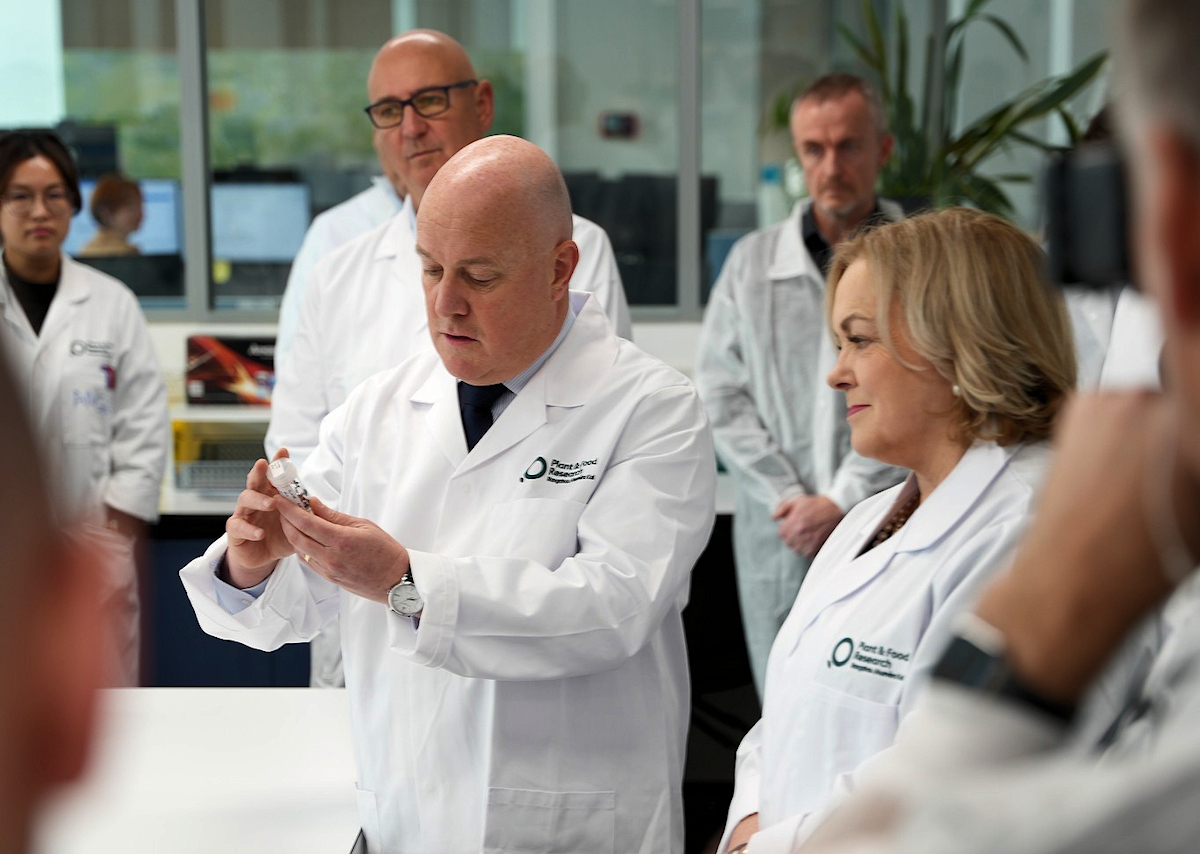
The Government yesterday moved on the key remaining plank in Federated Farmers’ conditions before agreeing to have farmers pay for methane emissions.
Science and Technology Minister Judith Collins’s announcement that legislation to overturn the current ban will be introduced before the end of the year honours an election campaign promise she made.
And it also keeps faith with any number of scientific leaders like Sir Peter Gluckman and Dr William Rolleston who have campaigned to have the ban relaxed.
The need to lift the ban has been made more urgent by the 2030 deadline National has imposed for farmers to begin paying for greenhouse gas emissions like methane.
At the same time there is the promise of a number of GE edited biological solutions which would reduce methane emissions from ruminant animals like cows.
One such solution, a ryegrass, which has been developed by the government-owned Ag Research at Massey, could reduce bovine methane emissions by as much as 15 per cent.
However, though it has been developed in a sealed laboratory at Massey, it has had to be tested in the United States because it cannot yet be planted in New Zealand.
Federated Farmer’s national executive yesterday met in Wellington and after discussing Collins’ announcement its president, Wayne Langford, said: “”Today’s announcement from the Government opens the door for us to consider all the potential benefits, weigh them up against any risks, and decide how we want to move forward together as a country.”
“There are huge opportunities to help us reduce our greenhouse gas emissions, improve drought resilience, or increase our farm production using these technologies.,” he said.
There were also potential conservation benefits, like eradicating possums that were spreading disease and decimating native forests, and benefits for healthcare.
“These aren’t just imaginary concepts – they’re real possibilities,” he said.
Back in June when the Government cancelled the He Waka Eke Noa agricultural consortium agreement on greenhouse gas emissions, Federated Farmers repeated its three bottom lines before it would agree to emissions pricing.
They were that methane targets would be reviewed, viable and cost-effective tools would be available for farmers, and no emissions leakage would occur.
The Government is already reviewing the targets.
Leakage, which means farm production dropping in New Zealand because of the costs of climate change compliance and that production being replaced in overseas markets by other countries.
It is an amorphous concept at best and unlikely to ever be convincingly proved one way or the other.
So, that leaves methane.
The stark alternative to not finding an on-farm solution to methane emissions was spelt out by Greenpeace yesterday.
The organisation’s spokesperson, Sinéad Deighton-O’Flynn, said, “While it’s good to see the Government finally acknowledging the dairy industry’s major role in the climate crisis, as-yet unproven genetically engineered methane inhibitors will not solve New Zealand dairy’s climate pollution problem.
“The problem is simple, and the solution is simple too. New Zealand has way too many cows fed with imported feed like rainforest-destroying palm kernel and grass grown with vast quantities of synthetic nitrogen fertiliser.
“The solution is to significantly reduce cow numbers and end the use of palm kernel and synthetic nitrogen fertiliser.
“These are things we know will substantially reduce climate pollution. Genetically engineered techno-fixes are a risky distraction.”
During the election campaign, National promised farmers it would “give them the tools” to reduce emissions before introducing pricing in 20230.
Agriculture spokesperson Todd McClay defined those tools as “promising biotechnologies like methane inhibitors, animal vaccines, gene-edited grasses, and advanced animal feed.”
“National believes the solution to agricultural emissions is through technology, not by sacrificing our largest export sector or blanketing agricultural land in pine trees,” he said.
Ag Research has developed a ryegrass that may reduce methane emissions from cattle by up to 15 per cent.
However, because New Zealand restricts the growing of gene-edited crops, the ryegrass trials must take place in the United States.
Last month, Ag Research said that it would soon be lodging a formal application with the Environmental Protection Authority (EPA) for another genetically edited ryegrass. This ryegrass had genetic additions that would deter insect pests from eating it and improve plant growth and persistence, “which collectively results in a reduced need for chemical pesticides and increases efficiencies in milk and meat production for New Zealand.”
The last approval of its type for an outdoor plant growing trial in New Zealand was by the then Environmental Risk Management Authority in December 2010, when the research institute Scion was allowed to grow genetically modified Radiata pine trees.
Ag Research said that as part of the application process, it would engage with various interested and affected parties with its partners to understand and address any concerns that were raised.
Meanwhile, outdoor trialling of the gene-edited ryegrass is underway in Australia, and the ryegrass seed has recently been sown in both Victoria and New South Wales.
Collins said yesterday that the proposed legislation would be based on Australia’s Gene Technology Act and would take a ‘hybrid approach’ to regulation, with applications assessed under a risk framework.
“This means we will regulate higher-risk activities and exclude some low-risk gene editing activities from regulation,” she said.
A hybrid approach would mean specific, low-risk, well-understood gene technologies could be exempted from regulations.
National has been talking about lifting the ban on genetically edited organisms from when it went into Opposition in 2017.
At a key Blue-Greens Forum in 2019, the former Prime Minister’s Science Advisor, Sir Peter Gluckman, said he could not see agriculture remaining sustainable without embracing GE.
“I’ll go as far as to say that I cannot see a way that agriculture in New Zealand will be sustainable over the long run in the face of environmental change and consumer preferences without using gene editing,” he said.
“There is no way that we will get a reduction in methane production, and I can see no way that we will see an economic advantage for farmers as we shift to more plant-based foods without using gene editing.”
That message was given added force as the reality of having to reduce methane from ruminant animals began to be realised across livestock farming.
By 2030 farmers will have to be starting to get methane emissions down.
That is what this move yesterday is all about.