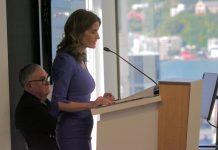
Finance Minister Nicola Willis sure knows how to dish it out.
She showed that yesterday at her Half-Yearly Economic and Fiscal Update media conference.
Her own department, Treasury, got a serve for getting its forecasts wrong.
Labour, of course, was blamed for the deeper than forecast economic downturn this year.
And the Taxpayers Union were attacked for their advocacy of a level of human misery that she said she was not prepared to tolerate.
Altogether, what she was really saying was that she wasn’t to blame for the need to push the forecast surplus and attendant debt reduction out yet another year.
She needed to deflect the blame.
After all, National’s 2023 election campaign Fiscal Plan had promised we would be back in surplus by $2.9 billion next year.
That is now a deficit of $16.9 billion (using the same measure of the deficit that National used for its plan).
But Willis has revised the method of calculating the deficit to produce a more sympathetic figure by including revenue from ACC, but even using that OBEGAL, the surplus will now not come until 2030
That is as far as the forecasts, and the traditional OBEGASL forecast shows the Government still with a small deficit that year.
| June years | 2023 | 2024 | 2025 | 2026 | 2027 | 2028 | 2029 | 2030 | |
|---|---|---|---|---|---|---|---|---|---|
| $millions | Actual | Actual | Actual | Forecast | Forecast | Forecast | Forecast | Forecast | |
| Revenue and expenses | |||||||||
| Total Crown revenue | 153,011 | 167,347 | 169,811 | 172,912 | 182,610 | 192,228 | 202,858 | 213,085 | |
| Total Crown expenses | 161,822 | 180,061 | 183,502 | 189,834 | 195,492 | 199,661 | 205,754 | 212,786 | |
| Fiscal strategy indicators | |||||||||
| OBEGAL (excluding ACC) | (7,199) | (8,773) | (9,306) | (13,852) | (10,362) | (5,121) | (945) | 2,299 | |
| OBEGAL | (9,446) | (12,854) | (13,973) | (16,934) | (12,985) | (7,704) | (3,258) | (60) | |
| Net core Crown debt | 155,273 | 175,464 | 182,171 | 196,987 | 220,568 | 235,661 | 246,760 | 253,905 | |
| Fiscal strategy indicators %GDP | |||||||||
| OBEGAL (excluding ACC) | (1.8%) | (2.1%) | (2.1%) | (3.0%) | (2.2%) | (1.0%) | (0.2%) | 0.4% | |
| OBEGAL | (2.4%) | (3.1%) | (3.2%) | (3.7%) | (2.7%) | (1.5%) | (0.6%) | (0.0%) | |
| Net core Crown debt | 38.7% | 41.8% | 41.8% | 43.3% | 46.0% | 46.9% | 46.9% | 46.1% |
This is all far cry from the optimism of 2023.
Then the 2023 HYEFU forecast the traditional OBEGAL surplus would appear in 2027.
So, Willis’s blame game was to try to explain what had gone wrong.
It seems the problem had its origins in the September 2023 Pre-Election Update.
“The Treasury was feeling very, in fact, overly optimistic about the economic outlook,” she said.
“It turns out, with the benefit of hindsight, that their forecasts were far too optimistic, and some of the assumptions made at that time have since been unwound.
“The revisions have reduced revenue and increased expenses relative to previous forecasts.”
The net result was that the OBEGAL forecast track was lower now than it was in 2023.
At which point Willis pointed her finger straight at Treasury.
“That is almost entirely due to the impact of these economic forecast revisions,” she said.
“It is not the result of discretionary government policy changes.
Willis has a point.
The 2023 PREFU was wildly optimistic.
It forecast a $6.1 billion deficit in this year’s Budget; it was actually $14 billion.
What Treasury had failed to forecast back in 2023 was the impact of Reserve Bank Governor Adrian Orr’s November 2022 exhortation to the economy to cool its jets.
He played his part by keeping the Official Cash Rate (OCR) up.
In October 2022, the OCR was at 3.5 per cent. From November 2022 until August last year, it remained above 5 per cent and did not return to 3.5 until April this year.
Treasury Secretary Iain Rennie conceded this yesterday.
“The economy’s been going through a prolonged downturn that was necessitated as the Reserve Bank went through its tightening monetary policy cycle to get inflation back within the inflation band,” he said.
But when the Bank began to lower interest rates in October last year, that didn’t have the stimulatory effect on the economy that the Treasury had expected, and Willis had hoped.
Rennie offered an explanation.
“This year we’ve seen elevated levels of global uncertainty flying from, for example, changes in the US administration’s tariff policy that certainly weighed on both business and household sentiment in New Zealand.
“So over the first half of this year, activity was flat.
“We saw a weakening in business investment, an increase in unemployment, and more of a geographic story with very much a two-speed economy; strength in the South Island and the rural areas, supported by generally high commodity prices and much weaker urban areas, particularly Auckland and Wellington.”
And Willis said that it didn’t really become apparent until after the Budget in May.
“The pick-up was slightly slower and slightly weaker, at least initially, than was forecast earlier this year at the Budget Update,” she said.
“That means that tax revenue is a little lower in total across the forecast period.
“At the same time, expenses are a little higher, for example, benefit expenses, which relate to the slower pick-up in the economy.
“And together, that means that the OBEGAL extract is slightly lower than at the Budget update, reaching surplus in 2930, a year later than previously expected.”
However, what is also apparent from the documentation published yesterday is that making even the extended OBEGAL target is going to place severe pressures on Government finances.
Willis is setting the Budget Operating Allowance (the additional money for new spending) at $2.4 billion for each year out to 2029.
” Much of this has already been pre-committed to health in particular, and some other areas,” Willis said yesterday.
“What this means is that most government agencies and ministers will need to plan to manage service pressures and other commitments with little or no additional funding.
“This will be challenging. Health, education, defence and law and order will be priorities for any new expenditure.
“Above what is left in the operating allowance, any new funding for priority initiatives and service pressures in Budget 2026 will need to be found from savings and reprioritisation.”
There are two pressure areas on Government finances: health and superannuation.
Willis’s Health forecasts are brave.
She is forecasting an increase in Vote Health in the next Budget of nearly 10 per cent, but thereafter, Treasury is forecasting it to rise at three per cent or less, little more than inflation.
The insurance brokers, Aon, reckon in their Global Health Trends survey that New Zealand health inflation has been averaging about 10 per cent a year.
Treasury’s New Zealand Superannuation forecasts show that already the country is spending almost the same on Super as it does on purchasing hospital and primary health services.
By 2030, 18 per cent of all Core Crown Spending will be on Super and 16 per cent on health services.
However, Willis believes there will need to be changes, though not yet.
“For those aged 65 and older who are relying on that income, they would see it as a priority, yes, because the government has made a commitment to them that that income will be available to them and we will keep our commitments,” she said.
“As we look to the future, it is going to be incumbent on all serious political parties to outline how they will meet the growing burden of superannuation costs as the proportion of workers to retirees reduces.
“For our part, in the National Party, we’ve set out our view that KiwiSaver savings are going to play a much bigger role in the future, and we’ve made a significant commitment to increase minimum contributions from 6% to 12% over time.
“That’s a very important first step, and all political parties will have to set up their views on superannuation at the next election.”
By defending transfer payments like Super, Willis has to confront the Taxpayers’ Union and their demands for tough cuts in areas like Working for Families.
But it has given her an opportunity to appear less hard-edged and brutal in her quest for a Budget surplus.
“This would take money away from 330,000 Kiwi families who, overnight, would lose, on average, around $180 a week,” said Willis.
“Beneficiary and low-income working families would bear the biggest brunt.
“A sharp correction of this sort would also depress demand in the economy, just as it is recovering.
“It would create a level of human misery that I, for one, am not prepared to tolerate.”
However, Willis’s path towards her surplus in 2030 is fraught with danger.

She has left herself little wiggle room in her spending allowances, and though Treasury is forecasting GDP to grow by over two per cent a year for the next three years, it has it falling back to 1.4 per cent in 2028.
Much then depends on whether the Government can get growth that is ahead of the forecasts.
But time does help. Rennie said tax revenue as a percentage of GDP would rise a little bit through the forecast period.
“In part that reflects the impact of fiscal drag on wages and salaries being moved into higher wage frames over time,” he said.
(That is, of course, assuming the Government doesn’t offer any more income tax cuts).
On the other hand, Willis has been prepared to be brutal, where she presumably thinks she can get away with it politically.
Thus, this sentence in the HYEFU: “Some significant savings (ie, pay equity) from the previous financial year flowed through to reduce core Crown, while from 2025/26 these savings have been used to fund the expenditure from new spending initiatives.”
Ultimately, though, yesterday’s document might have been prepared by Treasury, but as Willis was concerned, it was a political document.
“The biggest threat to the surplus right now is the election of a Labour-Green government,” she said.
“Unfortunately for Labour, having opposed every saving that we’ve delivered, they cannot take a position of responsible fiscal management.”
And there was more.
“They can’t claim that they have learned the mistakes of their last period in government and then resile from any savings in future,” she said.
“The simple reality is they outspend every Budget they ever committed to.
“They were very wasteful in that spending.
“They didn’t deliver value for the spending they did, and they want to repeat that cycle all over again.
“That would be a dangerous cause for New Zealand.
“Not just for our books, but for every taxpayer who would end up paying extra tax to fund it.”
Willis was a champion University debater, where it is an old-established practice that when you are on the back foot, you lay into your opponents.
But maybe reaching a surplus is not quite as important as Willis thinks it is.
Certainly, New Zealand First would argue that taking a little longer to get there would be no bad thing.
Willis’s problem is that she has breached one of Helen Clark’s cardinal rules of politics: under-promise and over-deliver.
There will be another economic update from Treasury with the Budget next year.
If that pushes the surplus out for yet another year, she will surely have real credibility problems; that is, unless she can find a way to blame Treasury.