
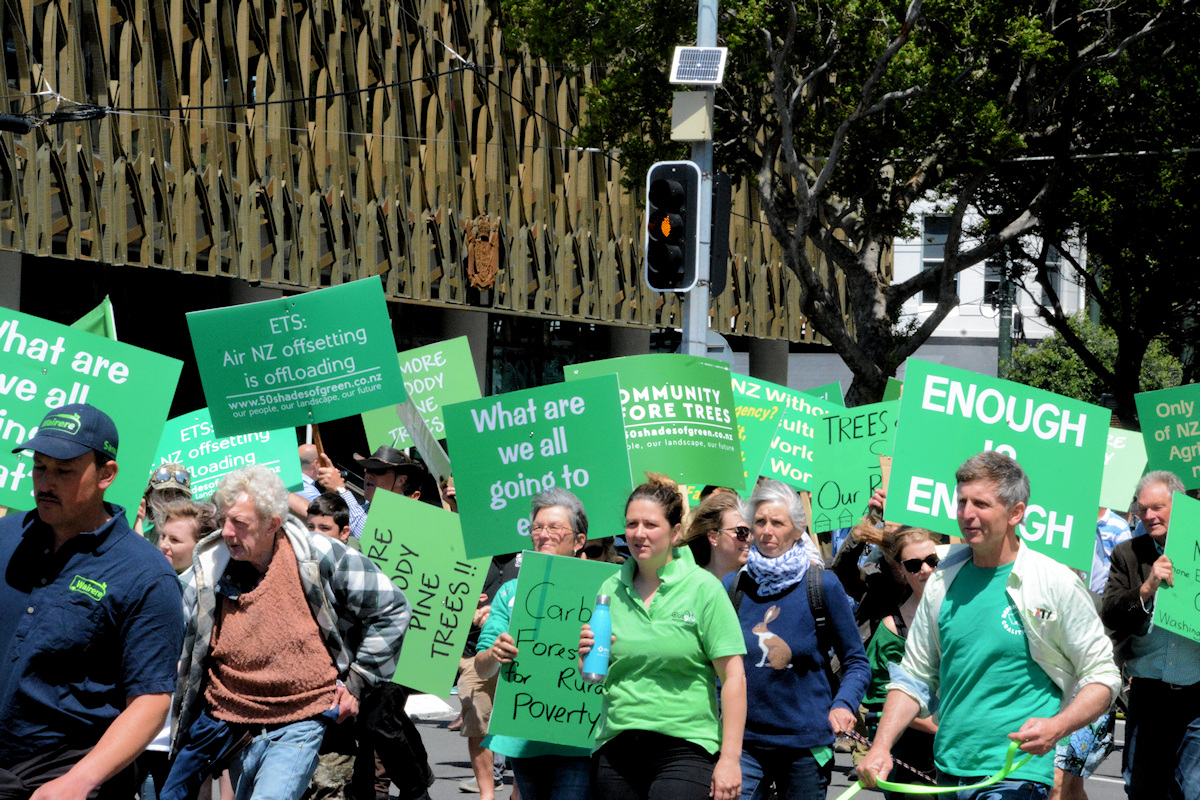
The Government is coming under increasing pressure to pull out of the Paris Climate Change Accord.
It is caught, alone and at odds with its two coalition partners and left to make some very hard political decisions.
Both ACT and New Zealand First want out of the Paris Accord.
Meanwhile the populist farm movement, Groundswell, is challenging the traditional farmer leadership organisations with its simplistic call for a withdrawal from Paris.
All of this was clearly visible at a Select Committee meeting yesterday over legislation to restrict the ability of farmers to convert their land to carbon farming.
The Prime Minister, up to now, has been content to let his coalition partners go it alone when they wanted to push things National didn’t support, like the Treaty Principles Bill.
But he has been adamant that he will not give in to them on climate change by pulling out of the Paris Accord.
“Do not be naive and think there will not be implications if we leave a global commitment,” he told farmers at the Fieldays last month.
But Luxon’s problems with the politics of climate change don’t stop there.
Pressured by many (but not all) farmers, the Government is proposing to restrict the planting of carbon forests to classes seven and eight land, which tends to be steep, erodible hills.
So, it has the Climate Change Response (Emissions Trading Scheme—Forestry Conversion) Amendment Bill before the Environment Committee at present, and the hearings have turned into a de facto debate on the Emissions Trading Scheme and the Paris Accord.
However, the hearings reek of partisan and self-interested politics.
The big supporters of the Government’s move – except that they don’t think it has gone far enough – are Beet + Lamb NZ.
Their chair, Kate Acland, told the Committee they desperately needed some limits on the amount of productive farmland that could be entered into the Emissions Trading Scheme (ETS) by planting forests for carbon credits.
“On behalf of New Zealand’s red meat farming community, we’re urging the government to go further,” she said.
“We know that since 2017 at least 300,000 hectares of whole farms have been sold for conversion into forestry, and that’s been driven by the ETS, so you know to be very clear it is not the profitability of forestry that’s driving these plantings, it’s the lucrative financial returns that can’t be made from carbon farming.
“It’s having a significant impact on the sheep and beef sector.
“Sheep numbers have decreased by 20% since 2017, and we estimate that about 70% of that is due to the ETS, so it’s really critical that we get the legislation right.”
A Hawkes Bay farmer, Lou Bell-Martin, put a human face on the statistics.
“I spoke with vet services in Waipukurau regarding the impact on their business of afforestation,” she said.
“Fifteen to 20 years ago, they scanned 1.2 million ewes. This year, it’s been less than 400,000.
“I also spoke with our shearing contractor. Ten years ago, he employed 100 to 200 people over the peak period. Now he employs 45 to 65.
The work is no longer consistent, and most shearers are now welfare-dependent. His income over the last five years has reduced by 30 to 35%.”
But the pain is not going to stop.
The Climate Change Commission’s review of the 2050 targets, published last December, forecast that sheep numbers by 2050 would fall by as much as 40 per cent to between 17 and 18 million.
The Commission put the challenge facing New Zealand very simply.
“Storing carbon in forests is less durable than not emitting fossil carbon in the first place,” they said.
The Parliamentary Commissioner for the Environment, Simon Upton, offered a similar view when he appeared in front of the Committee yesterday.
“At the end of the day, we have an emissions trading scheme to reduce our emissions, but we’re not being very successful at that,” he said.
“We are covering large areas of New Zealand in not very permanent trees, which have to be kept there permanently.
“That will ultimately blow up in our face.
“So I think what’s needed actually is a cross-party determination to take this off the off-the-front burner and come up with a sensible transition that can take us out of where we are at present.”
That sensible transition would take forestry out of the ETS and thus require a more aggressive approach to reducing fossil fuel emissions.
ACT is opposed to this.
The party’s environmental spokesperson, Simon Court, asked question after question, testing submitters on whether they supported New Zealand staying in the Paris Climate Change Accord.
“I’m wondering whether all of this tinkering around with the ETS could be alleviated if we actually went back to first principles and said why on earth have we adopted these very strict targets, why did previous ministers go to Paris, , and say that they were going to try and halve our emissions by 2030,” he asked Upton.
“Is any of this stuff still necessary?
“And maybe we should take another look at that rather than tinkering around with the ETS.”
Upton replied: “Well, if your view is that climate isn’t a problem worth addressing, Mr Court, you might well take that approach. I think it is a problem that all countries have to work together to do something about. So before I gave up on targets to actually do something, I’d try and do something.”
But there were submitters who agreed with Court, most notably Groundswell.
Their environmental spokesperson, Jamie McFadden, told the Committee that the problem was not forestry or tinkering with the ETS forestry regulations.
“That sort of thing is actually focused on the wrong issue,” he said.
“The problem is the Paris Accord or Paris Agreement.
“What we’ve done in our submission is we’ve listed multiple detrimental outcomes, and we would note that all of those outcomes would not be an issue if we were not in the Paris agreement.”
McFadden’s comments drew a response from National’s Wairarapa MP, Mike Butterick, who was one of the founders of the Fifty Shades of Green rural protest group, which was one of the first to highlight the challenges carbon farming was presenting to sheep and beef farming.
“I don’t disagree that our rural communities are very special places and rural people contribute to a whole lot of community good, such as firefighting and all the rest of it,” he said.
He argued that it was the markets, like the EU, that were demanding that New Zealand adhere to the Paris Agreement.
“In terms of some of the pressures on sheep and beef farming, number one has been profitability.
“We’re in a really good spot right now; record product prices all on the back of those lucrative markets that do have those (climate change) agreements, that profitability would be at risk.
Carbon farming does have its supporters.
Animal Justice Auckland argued that anything that prevented animals from being slaughtered for meat was a good thing, and carbon forestry conversions did that.
A more cynical submission came from Energy Resources Aotearoa, for whom the trees provide protection from the Government cracking down on fossil fuels.
“These are not easy times, and any change in land use brings disruption,” their CEO, John Carnegie, told the Committee.
“But solutions must be principled and consistent, not targeted at one land use over another.”
Carnegie said farmers and foresters had diverse investment profiles, and they were best placed to manage their land efficiently, and their property rights should be respected, too.
“We believe that restricting forestry only increases the costs of compliance for all sectors, including farming as a major fuel and electricity user, and raises the cost of the economic journey to a lower carbon economy, while at the same time the government seeks to implement a least cost solution for meeting climate targets,” he said.
And that is the crux of the debate.
Where should the costs lie in reducing our emissions targets?
The Climate Change Commission says that to reduce the methane target by just one per cent would mean we needed to reduce overall emissions by an amount equivalent to total emissions from 2022.
That would cost between $1.5 and $8.3 billion if we simply purchased international credits, or we could incentivise another 50,000 hectares of afforestation
It is these stark choices that the country is now starting to face. The problem for the Government, or the National Party part of it, is that its two coalition partners are not willing to join that debate.



