
Cracks have begun to appear in one of National’s landmark campaign promises to liberalise the use of gene technology in farming.
National promoted the idea to farmers as a simple way to reduce methane emissions and thus meet the 2050 zero-carbon targets.
National must have thought it would be a winner with the farming electorate, which it was keen to win back from ACT.
But polling by Federated Farmers shows that nearly a third of their members oppose liberalisation.
And though Fonterra supports liberalisation, it wants a much tighter regulatory regime than the Government is proposing.
National is under pressure from ACT and New Zealand First to withdraw from the Paris Climate Change Agreement. Though Federated Farmers has not yet gone that far, it wants the 2050 methane targets in the Zero Carbon legislation reviewed and lowered.
It is widely hoped that the main tool farmers might have to reduce methane emissions will be the Ag Research-developed genetically edited ryegrass, which is currently being tested in the United States to determine its ability to lower methane production in cows.
But under current legislation the grass cannot be grown in New Zealand.
Federated Farmers president Wayne Langford told the Health Select Committee yesterday that even if the law was changed, it might not be possible to approve the grass because it could spread to neighbouring properties that were marketing their produce as GE-free.
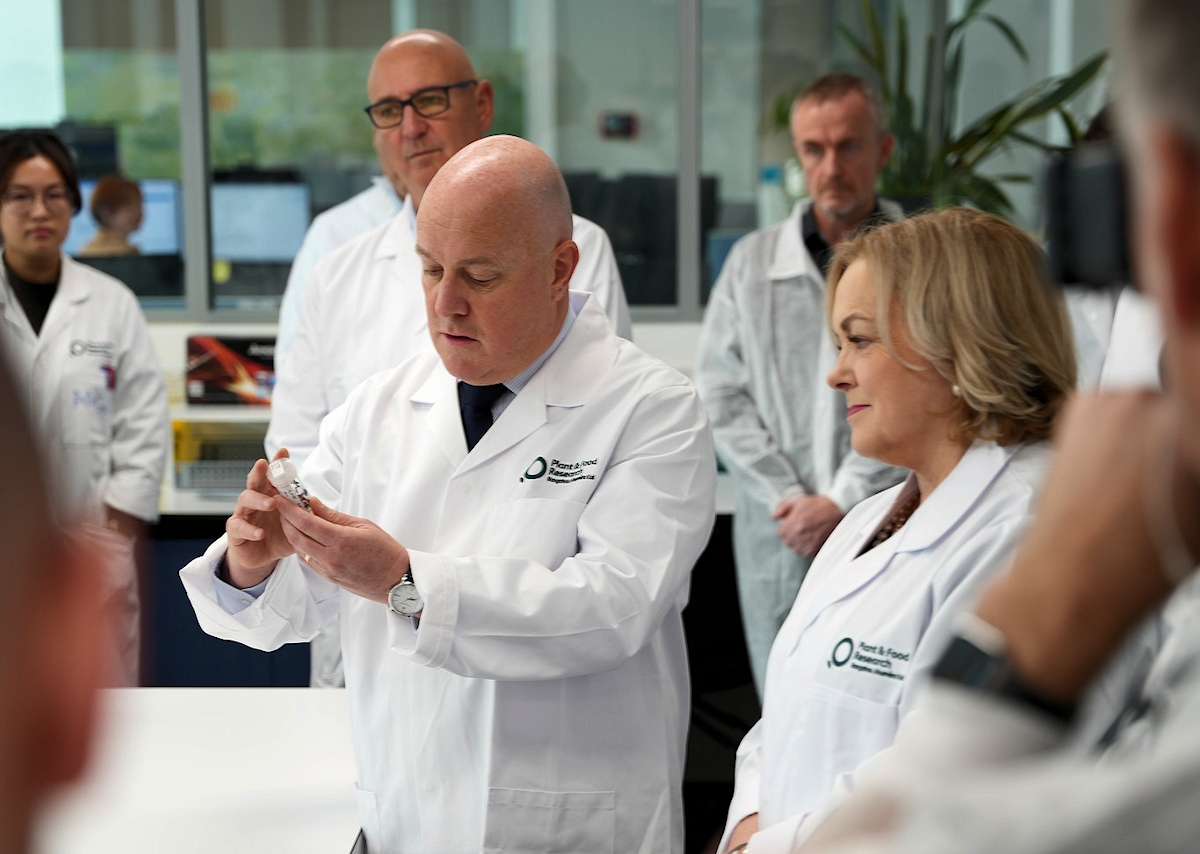
However, when Prime Minister Christopher Luxon unveiled National’s biotech policy in 2023, which hinged on freeing up the regulatory environment for gene-edited organisms, he was relentlessly positive about it.
“I see a huge upside for New Zealand,” he said on TVOne’s “Q+A”.
“The biggest risk is us actually not adopting our technologies and getting them up to speed and not dragging New Zealand into the 21st century. That’s the much bigger risk.”
Not quite, according to Fonterra.
Fonterra’s Director of Global External Affairs, Simon Tucker, told the Health Select Committee that Fonterra supported modernising the gene technology regulations.
“The bill’s risk-based framework provides opportunities in the near term to advance local research, particularly around new gene editing techniques and in the longer term, potentially lift on-farm productivity and deliver sustainability benefits,” he said.
But he said that support was balanced with the need to retain sensible regulatory safeguards.
Fonterra’s problem is that most of its major markets do not distinguish between traditional genetic modification and gene editing.
Traditional genetic Modification (GM) involves inserting genes from one organism into another, like creating herbicide-resistant crops.
In contrast, SDN-1 (Site-Directed Nuclease 1) edits do not involve introducing new genes from outside the organism but rather modifying existing ones.
The SDN-1 editing technology is the focus of the proposed legislation.
But because Fonterra’s markets don’t necessarily recognise that distinction, the co-operative wants tighter record keeping of what genetically edited organisms such as grass have been involved in producing any milk-based product.
Fonterra also proposed tightening the Bill’s exclusions relating to certain gene editing techniques.
“Although we recognise their potential, many key export markets currently classify organisms derived from these modern gene editing techniques the same as traditional genetically modified organisms,” said Fonterra executive, Ben Cunliffe.
“So, a minimum level of regulatory oversight is crucial to maintain transparency and visibility of such organisms for exporters.”
William Rolleston, a former President of Federated Farmers and now chair of the Life Sciences network, has been one of the leading advocates for liberalising the gene technology regulatory regime.
He was a keynote speaker at the recent Blue Greens Forum, making his case to National Party members.
However, Fonterra’s submission left him unimpressed.
“In my personal view, I think they’ve done a poor job in producing the submission that they did,” he said.
Rolleston opposed the kind of regulation Fonterra was [proposing being added to the Bill.
“Farmers do not need more inspectors marching across their land with tape measures and clipboards,” he said.
Instead, he said the market risks Fonterra was worried about should be managed by industry.
“If you look around the world and look at best practice, that’s actually managed by industry,” he said.
“Those risks are managed by the industry.
“I don’t see why the government should be putting in schemes that they’re going to have to charge farmers levies to manage those schemes when the industry is actually perfectly capable of managing those risks themselves.”
Alongside market risk, a number of farmer organisations brought up the question of “co-existence,” or how a gene-edited crop would be managed alongside a non-gene-edited crop or an organic orchard or farm.
Michelle Sands, General Manager of Strategy and Policy at Horticulture New Zealand, said the message her organisation received from most growers was that they wanted the opportunity to grow organic, conventional, or gene-tech.
“And they don’t want their neighbours’ ability to grow whatever they’re doing to impinge on theirs,” she said.
“So, we do seek regulation so people can take opportunities, but provided those risks can be managed and provided that the cost of whatever activity your neighbours are undertaking is not borne by you.”
Co-existence is a big issue for Federated Farmers, which has a sizable percentage of its membership that is opposed to liberalising the gene technology regulatory regime.
“Our members’ views on issues are as diverse as their farming systems,” said Federated Farmers President Wayne Langford.
“Most farmers are in support, some are neutral, and some are opposed.
“Federated farmers’ job is to navigate those differences in opinion, to present a credible and consistent view, which we try to do.”
Langford said the position of the Federated Farmers National Council was that it supported the reform and advocated for the benefits of genetic technology.
“But we also support a farmer’s right to include or exclude these technologies and any controls or systems required to enable us,” he said.
“Federated Farmers will be advocating through the development of regulation to ensure that the right to choose is preserved, ensuring that it is practical and workable for farmers to use whichever side of the fence you sit on.
“The right to choose is a major part of our theme and submission today.”
The Committee has been told that Ag Research cannot guarantee that its genetically edited ryegrass will not spread over time.
The Feds worry that a genetically edited crop on one property could easily spread uninvited to a neighbouring property.
If that neighbour were marketing their meat, milk, or fruit as organic, the whole basis of their business would be destroyed.
NZ First MP Mark Patterson told the Committee that it would be impossible to have a farm aiming to be GMO free with ryegrass spreading.
“How on earth are we going to co-exist that with perennial ryegrass? It’s impossible. We’ve heard it from Ag Research,” he said.
Langford conceded that because of these issues, the methane-busting ryegrass might not be able to be used, but that wouldn’t end the use of gene technology.
“So, there is a risk and that could be evaluated to be too high,” he said.
“And so, we could use gene technology in other areas.
“Just because ryegrass may not work doesn’t mean that we can’t do others.
This is going to be difficult for the Government to resolve.
Clearly, the main incentive to liberalise the gene technology regime was to enable the use of methane-busting ryegrass and thus provide an easy path for farmers to reduce their emissions.
But if Federated Farmers wants such tight controls in place to stop it from spreading, it becomes impossible to agree to its use, and the Government would be left in a quandary.
Would it risk angering the 23 per cent of Federated Farmers members opposed to the Bill?
National, when it was in Opposition, clearly wanted to tilt the playing field in favour of a liberal gene tech approval regime.
Decisions about the use of gene technology are currently made by the Environmental Protection Authority (EPA), but the Ministry of Business, Innovation and Employment (MBIE) noted in the Bill’s Regulatory Impact Statement that the EPA had been forced by Court decisions to take a more conservative approach when it came to dealing with gene technology questions.
“While the new gene technology regulator is proposed to operate under a clear legislative direction to be enabling, there are concerns, including from industry stakeholders, that despite this, the EPA may continue to take a conservative approach to GMO regulation,” the statement said.
So, the Government is proposing that gene technology regulation shift from the EPA to MBIE. (3/04/25: That is incorrect. The Bill propsoes the regulator be within the EPA)
The statement said one advantage of doing this would be the ability to implement the new regulatory regime on a clean slate, free from any perceived or actual regulatory tendencies associated with the more restrictive current regime.
But the Parliamentary Commissioner for the Environment, Simon Upton, disagreed,
“The EPA is a government entity which does what the law tells it to do,” he said.
“If you’re unhappy with the performance, the timeframes, the way things are dealt with, look at the law you’ve given them or the regulations you’ve put there.
“As a Parliamentary Commissioner for the Environment, I deal with the EPA from time to time. I have to say. It is, far and away, one of the most technically qualified agencies I have talked to.
“They know far more than ministry staff.
“The people who have to actually implement the stuff are serious technical people.
“I wouldn’t run down the EPA. You should look at the written instructions they’re given in the statutes that you pass.
“And I really do think, look, it’s a small country, for heaven’s sake. We don’t need yet another regulator. Get the EPA on the right course, doing a good job. That’s what you should do.”
What must have seemed simple and easy on the election campaign trail is now clearly not.



